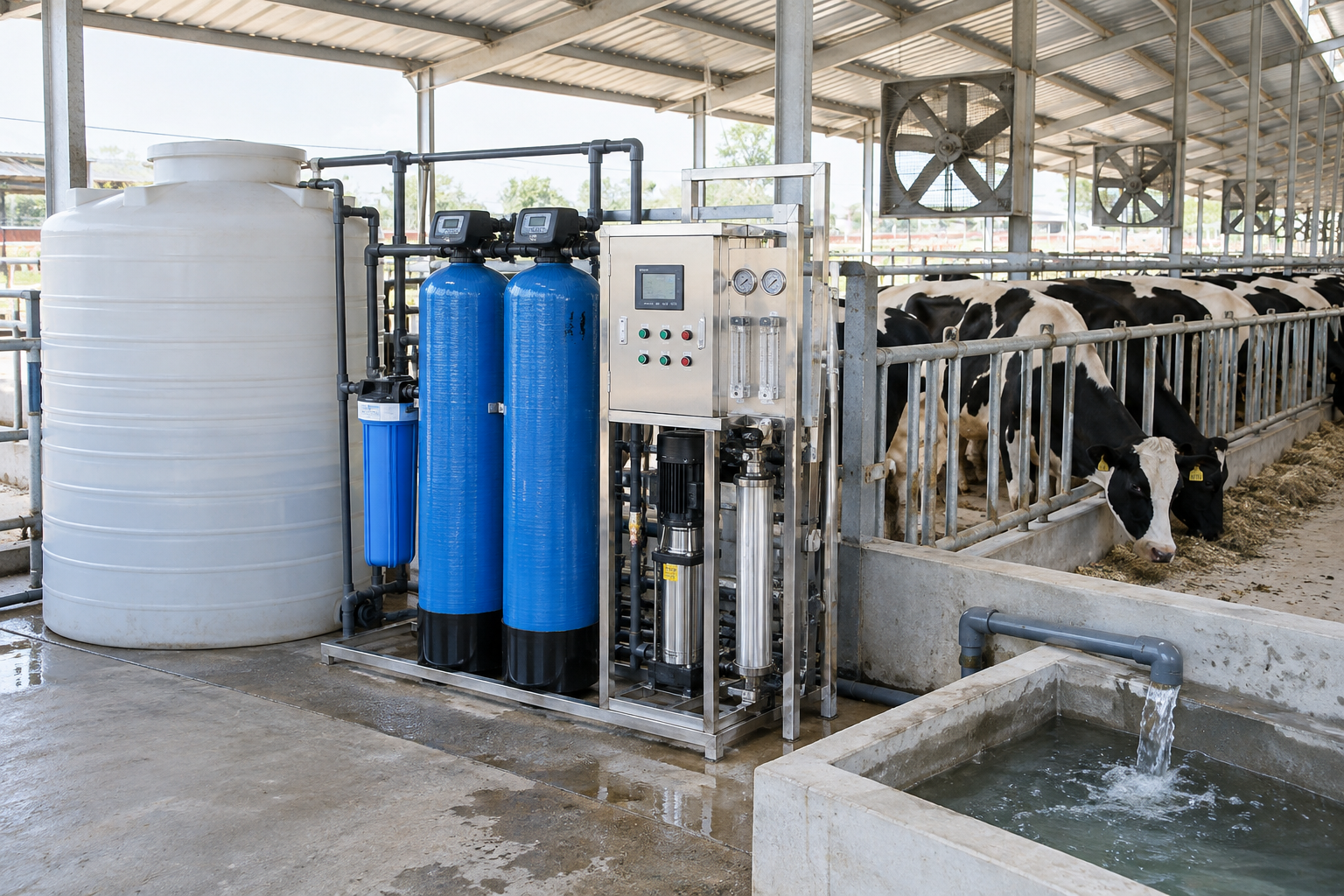
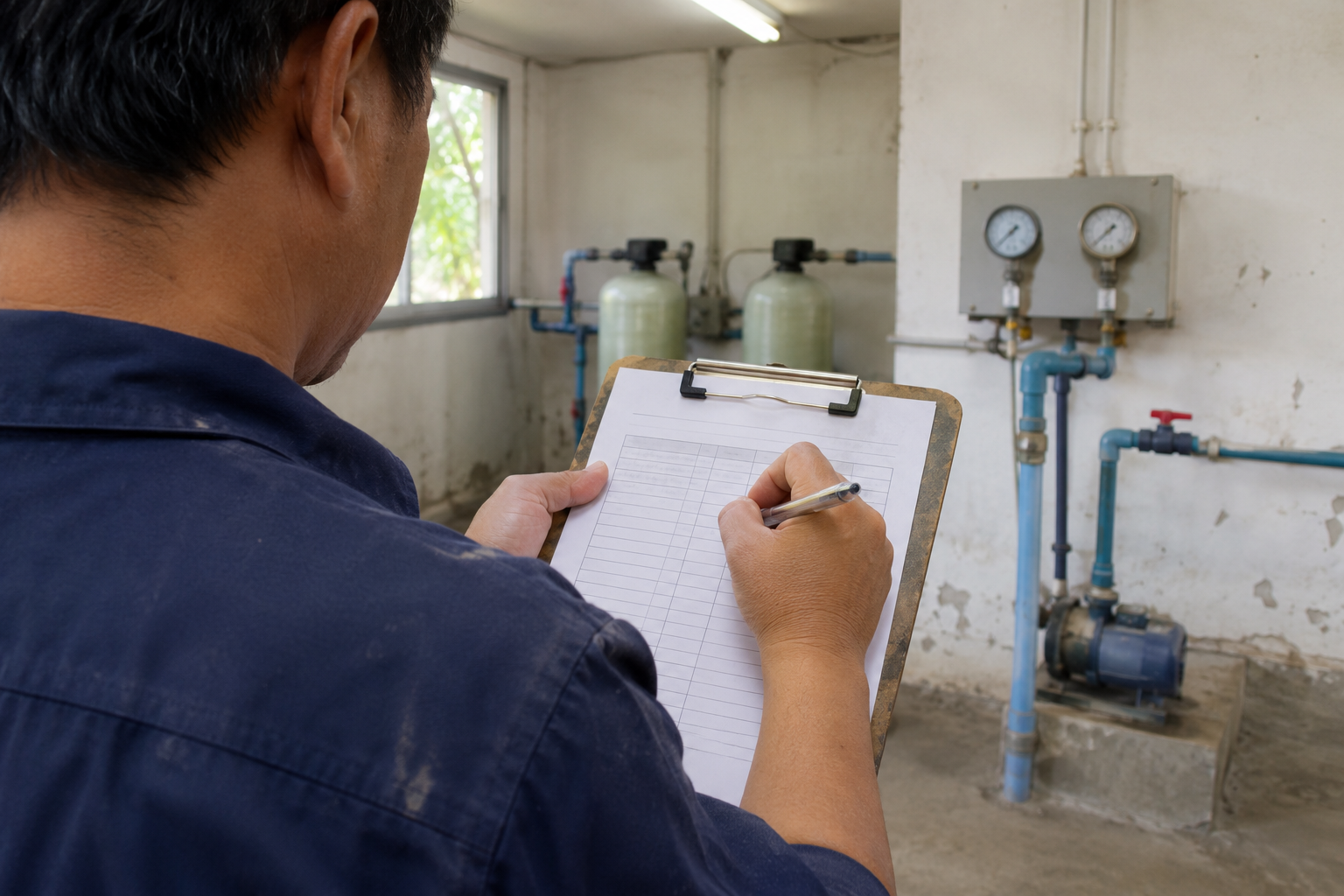
A useful RO daily checklist records product water flow, reject flow, relevant pressures, feed water temperature, and feed and product conductivity or TDS. Add the pretreatment checks required by your configuration, plus operating hours, alarms, and maintenance events.
Take readings during stable production and compare them with the baseline established at commissioning. One number rarely explains a problem on its own.
For a small business, the purpose is practical: give the operator a clear routine and give the service team enough information to investigate changes.
What Should Go in Your Daily RO Operating Log?
Use one row for each set of readings. Identify the system, operator, date, and time so records remain useful when different people operate the equipment.
Start with these fields, using the instruments installed on your system:
- Production status and operating hours.
- Feed water temperature.
- Permeate flow and final reject flow.
- Feed flow and recycle flow, where measured.
- Pressure readings at the labelled measurement points.
- Feed and permeate conductivity or TDS, with units.
- Required pretreatment test results.
- Alarms, leaks, unusual noise, or other observations.
- Maintenance, chemical refills, and operating changes.
Ask the supplier to mark the measurement points on a photo or drawing and provide normal ranges and action limits. A log headed simply “pressure” is ambiguous when several gauges are installed.
If an important measurement is unavailable, ask whether an instrument or sampling point should be added. Leave an unavailable reading blank and explain why rather than estimating it.
When Should You Take the Readings?
Record the normal comparison readings after startup and flushing are complete and production has stabilised, following the system’s operating procedure.
A startup reading, a flushing reading, and a stable production reading describe different conditions. If you record all three, label them clearly.
Agree on the recording frequency with your supplier. A stable, single-shift installation may use a daily production record, while variable water conditions or longer operating periods may require more frequent checks or continuous monitoring.
Daily recording does not replace alarms or continuous protection required by the design.
At commissioning, retain a complete set of accepted baseline readings, including water conditions and instrument settings. Keep the original baseline when recording later maintenance or configuration changes.
How Do You Tell Whether Performance Has Changed?
Review flow, pressure, temperature, and water quality together. A lower product flow does not automatically mean the membranes need cleaning.
For example, colder feed water can reduce output without indicating membrane fouling. Changes in feed salinity, pressure, or recovery can also affect the readings.
Service teams use performance normalisation to account for operating-condition changes when assessing membrane trends. Operators provide the measurements needed for that assessment; they do not need to perform the calculations manually.
Pressure drop also needs a defined location. The difference across a cartridge filter is a different measurement from the difference across a membrane stage. Do not subtract two convenient gauge readings unless they represent the intended inlet and outlet points.
Use consistent units. Record whether flow is in L/min or L/hour, pressure is in bar or another unit, and water quality is measured as conductivity or estimated TDS.
Which Pretreatment Checks Should You Include?
Choose checks that verify the treatment stages actually installed. The checklist for municipal water may differ from one for iron-bearing borehole water.
Depending on the configuration, include:
- Disinfectant residual at the agreed point before chlorine-sensitive membranes.
- Outlet hardness and regeneration status for a softener.
- Iron and manganese results where removal is required.
- Filter pressure loss and backwash completion.
- Chemical stock, dosing status, and relevant verification checks.
Your supplier should specify the test method, frequency, acceptance limit, and response for each item. Some checks may be continuous, some daily, and others periodic.
A pump running or an automatic valve completing its cycle does not, by itself, verify treatment performance.
What Should You Record When Something Changes?
Write down what happened and when. “Filter replaced” is less useful than a dated entry identifying the filter, replacement specification, reason for replacement, and readings before and after the work.
Record shutdowns, source-water changes, chemical changes, instrument calibration, membrane cleaning, component replacement, and authorised setting adjustments.
If a reading looks abnormal, first check the unit, operating status, and instrument according to the procedure. Compare the result with the agreed limits.
Follow the specified stop or product-diversion procedure when an action limit is exceeded. Send the service team recent logs and clear photos of the relevant instruments. Avoid changing several settings at once to recover the displayed output.
Cleaning or replacement decisions should use the manufacturer’s criteria and a review of the operating data, rather than one unexplained change.
How Do You Keep the Checklist Useful for Your Team?
Keep the form short enough to complete accurately, with a separate space for maintenance details. A paper sheet, shared spreadsheet, or suitable digital system can all work.
Check three things before putting the form into use:
- Does the operator know exactly where and when to take each reading?
- Does each important result have a normal range or an action limit?
- Is someone responsible for reviewing trends and following up abnormalities?
Review records regularly rather than filing them away until production stops. A useful log connects observations with decisions and records what action was taken.
AquaOxy helps small businesses select RO systems from 250 to 5,000 L/hour and define the operating information needed for their configuration.
Contact AquaOxy with your system configuration, instrument photos, and available operating records to discuss an appropriate monitoring checklist.