
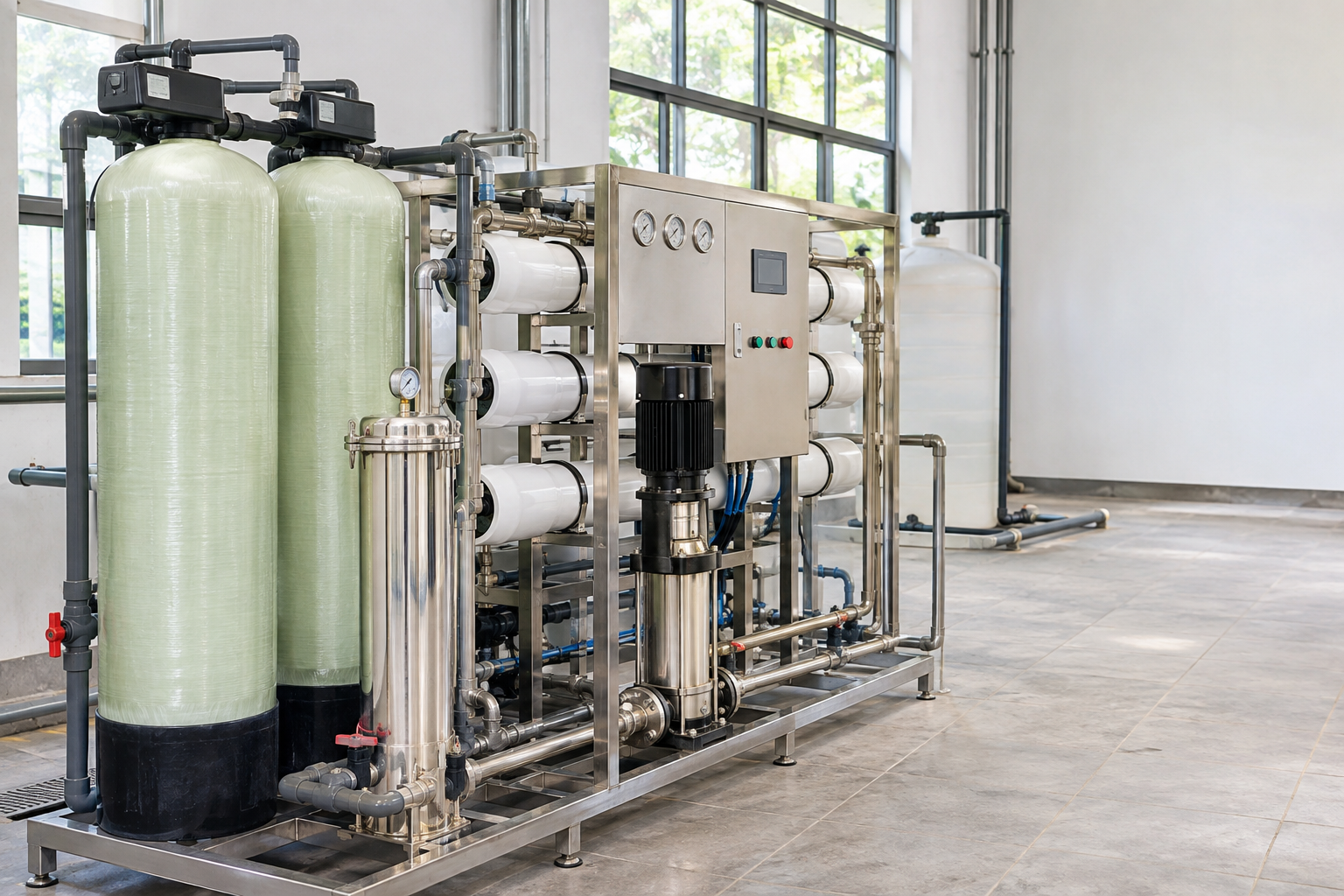
A reverse osmosis water filter system can produce high-quality water for drinking, food preparation, small businesses, and industrial processes. But choosing the right system involves more than selecting a filtration capacity or membrane brand.
The important questions are: What water are you treating? What quality do you need? How much water will you use each day? And can the system operate reliably under your local conditions?
Quick answer: A reverse osmosis (RO) system uses pressure and a semipermeable membrane to reduce dissolved salts and many other contaminants. For commercial applications, the right system is determined by source-water quality, required output, operating conditions, pretreatment and maintenance needs—not by capacity alone.
What Is a Reverse Osmosis Water Filter System?
A reverse osmosis water filter system is a water treatment system that separates treated water from dissolved impurities through a membrane process.
Unlike conventional sediment filters, which mainly remove suspended particles, reverse osmosis can reduce many dissolved substances, including salts and certain inorganic contaminants.
Most commercial RO installations combine several treatment stages. Depending on the water source, these may include sediment filtration, activated carbon, chemical dosing, cartridge filtration, an RO membrane system, and post-treatment.
How Does a Commercial RO System Work?
Water passes through pretreatment equipment before entering the RO membrane under pressure. The membrane separates the flow into two streams:
- Permeate: Treated water that passes through the membrane.
- Concentrate: Water carrying a higher concentration of rejected dissolved substances.
The ratio of permeate flow to incoming feed flow is called the system recovery rate. Recovery affects water consumption, concentrate discharge and scaling risk.
A higher recovery rate is not automatically a better design. The appropriate value depends on water chemistry, membrane arrangement, operating pressure and the system’s ability to control scaling.
Do You Actually Need Reverse Osmosis?
Not every water quality problem requires RO. If the main issue is suspended sediment, a suitable filtration system may be enough. If the concern is dissolved salts or specific dissolved contaminants, RO may be appropriate.
For microbial contamination, treatment must also consider adequate disinfection, hygienic storage, distribution and verification of the final water quality.
Before purchasing an RO system, identify the contaminants that need to be reduced and the quality required for the intended use.
Typical Commercial RO Treatment Process
Municipal, well or suitable brackish water
Media filtration, dechlorination or scaling control as required
Final particulate protection before the RO unit
Provides the pressure needed for membrane separation
Separate permeate and concentrate streams
Disinfection, storage or further polishing where required
Illustrative process only. Actual equipment sequence and treatment stages depend on source-water analysis and intended water use.
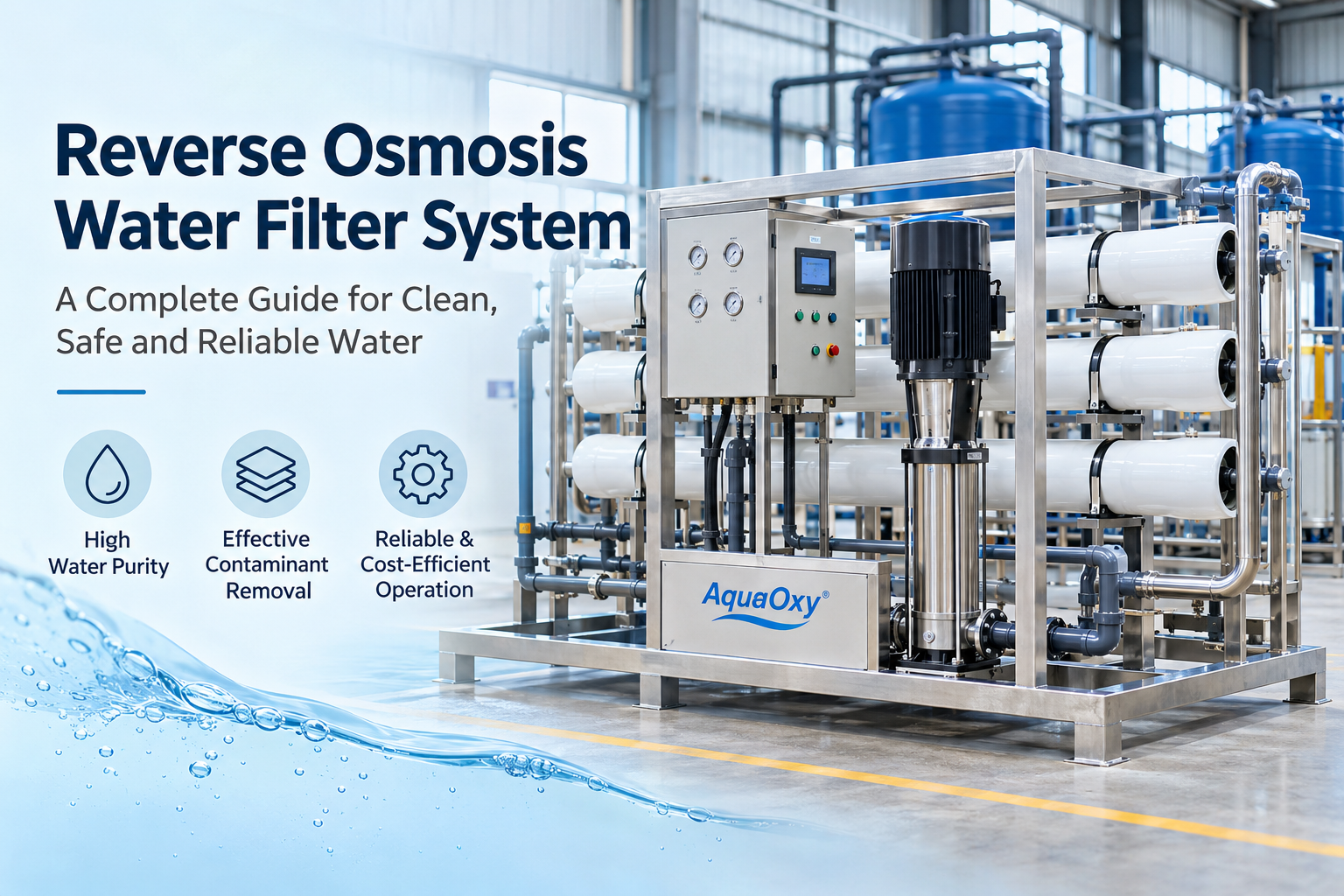
Why Two RO Systems With the Same Capacity Can Be Different
Consider two businesses that both need 1000 L/hour of treated water from boreholes. Their required output is identical, but their water quality is not.
| Water Parameter | Well A | Well B |
|---|---|---|
| TDS | 2000 mg/L | 2000 mg/L |
| Total Hardness | 100 mg/L as CaCO3 | 600 mg/L as CaCO3 |
| Total Iron | 0.05 mg/L | 2.0 mg/L |
| Design Concern | Salt removal and scaling assessment | Iron fouling and higher scaling potential |
| Possible Approach | Evaluate conventional pretreatment with suitable scale control | Assess iron removal, scale control and recovery limitations |
Illustrative comparison, not actual AquaOxy project data. Final treatment design requires a complete water analysis, including pH, alkalinity, calcium, sulfate, silica and other relevant parameters.
These two sources have the same TDS, but Well B presents greater risks of fouling and scaling. The appropriate pretreatment and operating conditions may therefore be different.
This is why a single TDS reading cannot determine the complete RO configuration.
Which Water Parameters Should You Test?
A representative water analysis should normally be reviewed before final equipment selection.
| Parameter | Why It Matters |
|---|---|
| TDS / Conductivity | Helps assess salinity and membrane pressure requirements |
| Hardness, Calcium and Magnesium | Contribute to mineral scaling risk |
| Iron and Manganese | Can cause fouling and may require additional pretreatment |
| Turbidity / SDI | Indicate particulate and colloidal fouling potential |
| pH, Alkalinity and Silica | Important for scaling assessment and chemical control |
| Chlorine / Oxidants | May damage chlorine-sensitive RO membranes |
| Microbiological Indicators | Help assess drinking-water safety and disinfection needs |
Actual membrane-feed limits must follow the selected membrane manufacturer’s requirements. Pretreatment should be designed to achieve those limits under real operating conditions.
For further technical reference, see the FilmTec Reverse Osmosis and Nanofiltration Membranes Technical Manual.
How Much Capacity Does Your Business Need?
Start with the daily amount of treated water required and the number of hours the system can operate.
Required hourly output = Daily treated-water demand / Available operating hours.
For example, a business requiring 8000 liters of treated water per day over eight operating hours needs a nominal output of 1000 L/hour.
However, the final system specification must consider actual feed temperature, salinity, membrane performance, downtime, peak demand, storage and any operating margin.
| Nominal Capacity | Output in 8 Hours |
|---|---|
| 250 L/hour | 2000 L |
| 500 L/hour | 4000 L |
| 1000 L/hour | 8000 L |
| 2000 L/hour | 16000 L |
| 3000 L/hour | 24000 L |
| 5000 L/hour | 40000 L |
The values above are arithmetic examples at continuous nominal production. They are not guaranteed daily production figures under all water and site conditions.
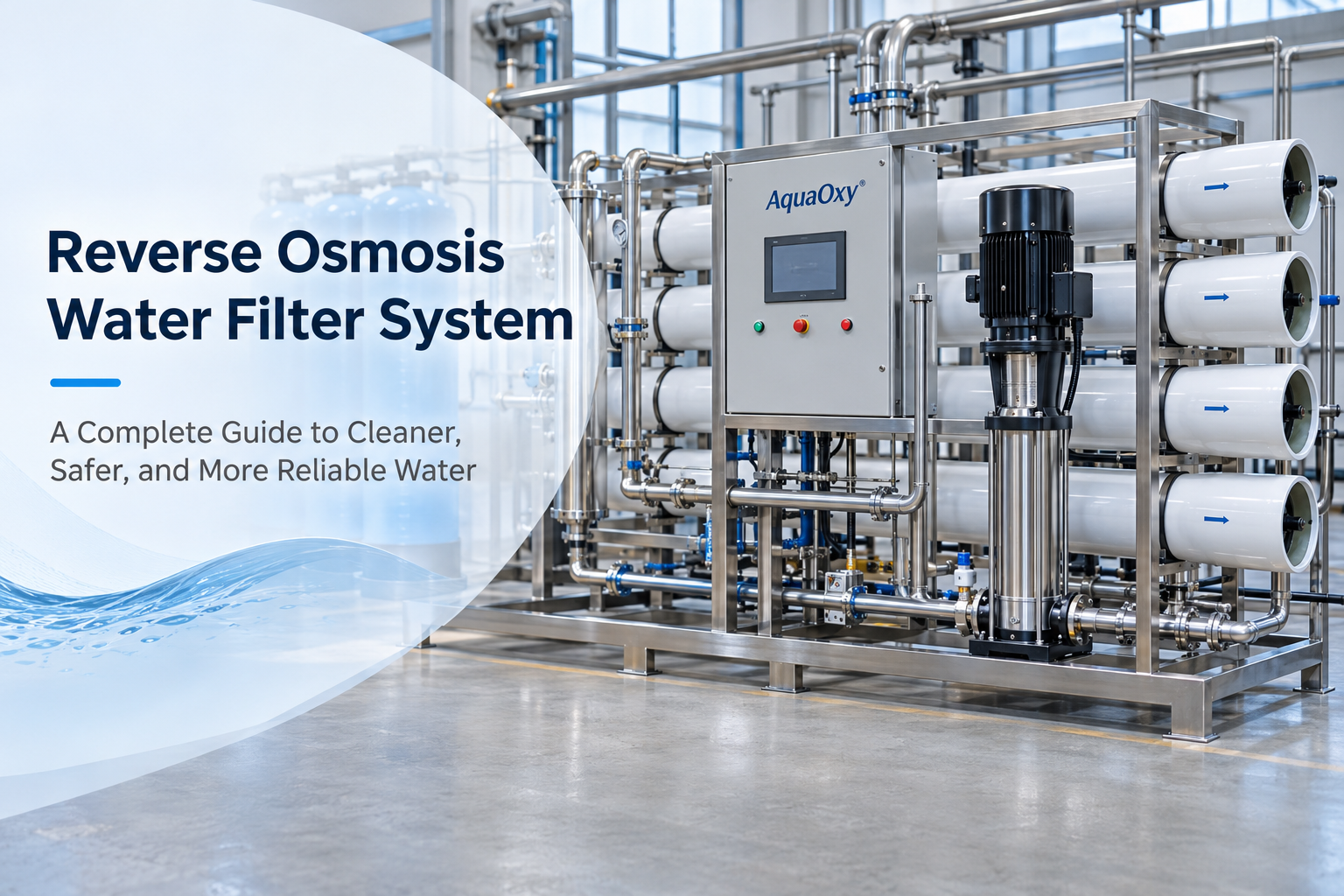
What Should You Compare Before Buying an RO System?
Two suppliers may quote the same nominal capacity while offering different pretreatment, membranes, pumps, control systems and after-sales support.
Before comparing prices, check the following:
- Design water quality: Does the quotation specify the source-water conditions used for the design?
- Actual production: Under what temperature, salinity and pressure conditions is the output rated?
- Pretreatment: Are filtration, iron removal, softening or chemical dosing included where necessary?
- Membrane and pump selection: Are the models suitable for the required operating pressure and water chemistry?
- Recovery and concentrate: Is there a reasonable operating recovery target and a practical reject-water discharge arrangement?
- Water quality target: Is the required treated-water quality clearly defined?
- Electrical supply: Does the equipment match the local voltage, frequency and power availability?
- Maintenance: Are spare parts, cartridges, membranes and cleaning procedures documented?
- Testing: What factory test records and acceptance criteria will be provided?
What About Operating Costs?
The purchase price is only one part of the overall cost. A commercial reverse osmosis water filter system also consumes electricity, feed water, replacement filters and, depending on the design, treatment chemicals.
Membrane cleaning, periodic replacement, labor and concentrate disposal may also contribute to operating expenses.
For example, if a system produces 1000 L/hour at a recovery rate of 60%, its theoretical feed-water requirement is approximately 1667 L/hour, with about 667 L/hour of concentrate.
This water balance illustrates why recovery matters. The actual recovery target must be determined from membrane configuration, scaling potential and operating conditions. It should not be selected simply to minimize wastewater.
When Is a Smaller or Simpler System the Better Choice?
A higher-capacity or more complex RO system is not always the most practical option.
If daily demand is moderate and treated water can be stored hygienically, a smaller system operating for longer hours may be more economical than an oversized unit.
Similarly, if source-water testing shows that conventional filtration and disinfection can meet the intended water-quality requirements, installing RO may introduce unnecessary cost and maintenance.
The objective is not to buy the most sophisticated equipment. It is to select the treatment process that meets the required water quality reliably.
A Practical Way to Choose Your RO Water Filter System
Before requesting a final quotation, prepare five pieces of information:
- Your source-water type and available water analysis.
- The intended application and treated-water quality requirement.
- Your required daily volume and expected operating hours.
- Your installation country, electrical supply and site constraints.
- Your local maintenance capability and any planned storage or filling equipment.
With this information, equipment suppliers can compare realistic configurations rather than quoting different machines under the same capacity label.
Find the Right RO System for Your Water
AquaOxy focuses on compact commercial RO systems from 250 to 5000 L/hour, configured around source-water conditions, application requirements and practical operating needs.
If you have a water analysis report, share it with us along with your required capacity and intended use. We can review the information and discuss a suitable treatment configuration, including any necessary pretreatment and post-treatment.
Share Your Water RequirementsFurther reading: FilmTec RO/NF Technical Manual and U.S. Department of Energy — Reverse Osmosis Optimization.


