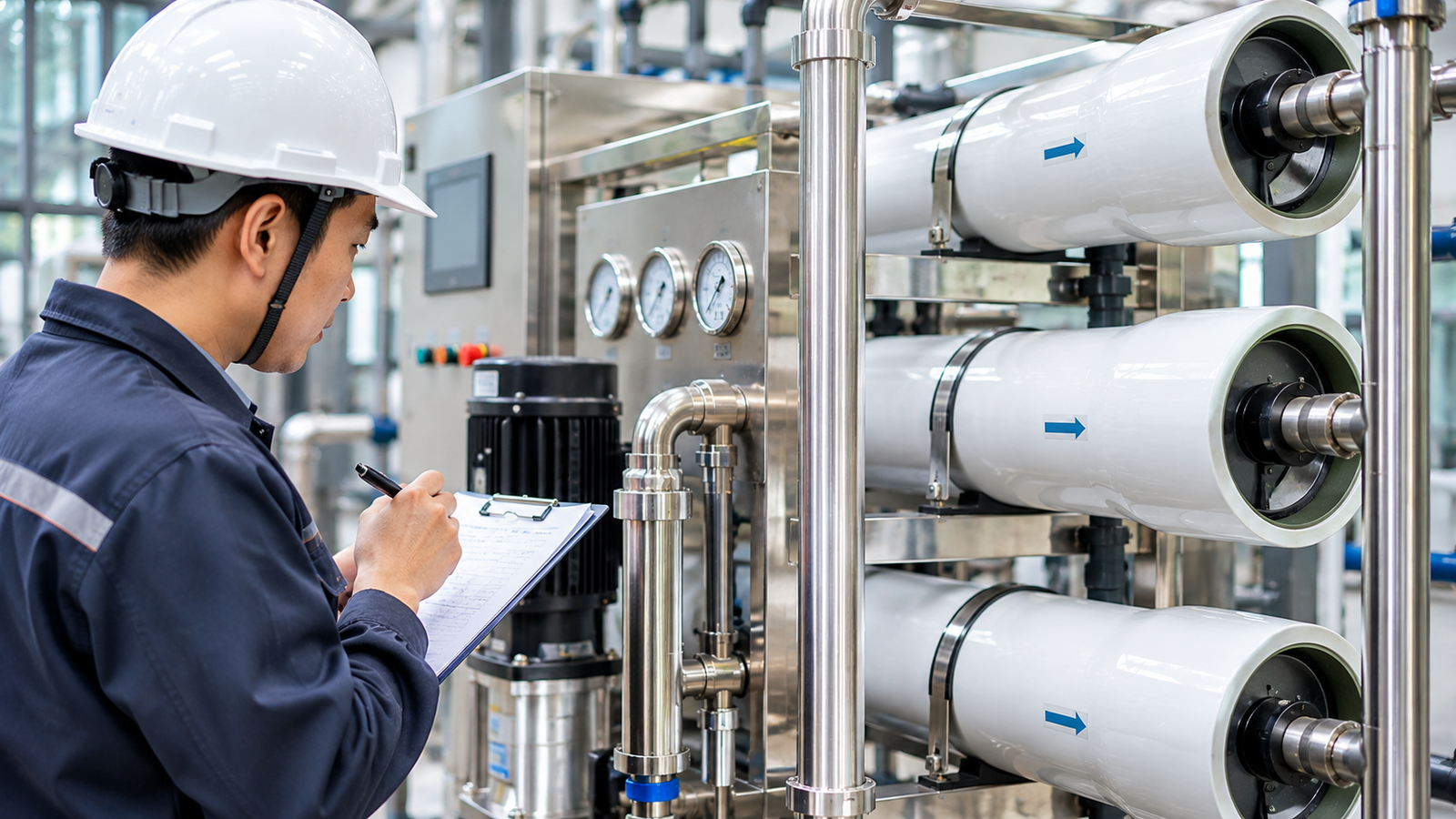
A 2000 LPH RO system can be a practical water treatment solution for a drinking-water business, hotel, small factory or commercial facility. But two systems with the same 2000 L/hour output can differ significantly in pretreatment, membrane configuration, operating pressure and long-term cost.
If you are comparing suppliers, the most important question is not simply how much the machine costs. It is whether the proposed system can produce the water you need, from your actual source, under your site’s operating conditions.
Quick answer: A 2000 LPH RO system is designed to produce approximately 2000 liters of treated water per hour under specified conditions. The final selection should be based on feed-water quality, required treated-water quality, daily demand, operating hours, membrane design and the complete scope of supply.
What Does 2000 LPH Mean in Real Production?
LPH stands for liters per hour. A 2000 LPH reverse osmosis system has a nominal permeate production capacity of 2000 L/hour, equivalent to 2 cubic meters per hour.
The amount of water available each day depends on how long the system operates at its rated output.
These figures are theoretical calculations at constant nominal production. Actual daily output may be lower because of membrane performance, feed-water temperature, cleaning, interruptions and other operating conditions.
For example, if your business requires 18,000 liters per day and you have 10 productive operating hours available, your average production requirement is 1800 L/hour. A 2000 L/hour system could be a suitable starting point, provided the design confirms that output under your feed-water conditions.
Where Is a 2000 LPH RO System Used?
This capacity is frequently considered for businesses that need a steady treated-water supply without investing in a much larger industrial plant.
Small Drinking-Water Businesses
Water bottling, jar-filling and sachet-water operations may require RO when the source water contains dissolved substances that need to be reduced. Production planning should also account for filling capacity, hygienic storage and disinfection.
Hotels and Commercial Facilities
A 2000 L/hour system may serve selected drinking-water, kitchen or process-water applications. It is not automatically necessary or economical to supply every building outlet with RO-treated water.
Food Processing and Small Factories
Businesses requiring controlled water quality for particular processes may use RO to reduce dissolved salts and other relevant contaminants. The treatment target should be defined by the production process rather than by a generic claim of water purity.
Borehole Water Treatment
For groundwater users, RO may be appropriate when dissolved salts or particular contaminants exceed the requirements of the intended application. However, hardness, iron, manganese and other water characteristics can significantly affect pretreatment and membrane operation.
How Much Feed Water Does a 2000 LPH RO System Require?
An RO system does not turn all incoming water into treated water. Part of the feed becomes permeate, while the remainder leaves as concentrate.
The basic relationship is:
Feed Water Flow = Permeate Flow / System Recovery
For example, a system producing 2000 L/hour at an assumed 60% recovery requires approximately 3333 L/hour of feed water and discharges approximately 1333 L/hour of concentrate.
This is only a water-balance example, not a recommended universal recovery target. The appropriate recovery must be checked against water chemistry, membrane arrangement, scaling potential and operating conditions.
What Specifications Matter for a 2000 LPH RO System?
A supplier’s specification sheet should help you understand what performance is being offered and under which conditions. A list of component brands is useful, but it cannot replace a defined design basis.
| Specification | What Buyers Should Confirm |
|---|---|
| Permeate capacity | 2000 L/hour under specified feed-water and operating conditions |
| Feed-water quality | Design TDS, temperature, hardness, iron, silica and relevant contaminants |
| Membranes | Brand, exact model, quantity, arrangement and calculated performance |
| High-pressure pump | Duty flow, pressure, materials and power requirements |
| System recovery | Design target supported by water chemistry and membrane calculations |
| Salt rejection | Membrane performance and expected product-water quality under defined conditions |
| Pretreatment | Required treatment stages and RO membrane-feed quality limits |
| Electrical supply | Actual voltage, phase, frequency and motor/control compatibility |
| Controls | Pressure, flow, conductivity, flushing and protection functions included |
Specifications such as 97–99% salt rejection or a 60–75% recovery range are sometimes shown in commercial quotations. These numbers should never be accepted as unconditional guarantees. Their meaning depends on the membrane, feed water, test conditions and system arrangement.
Why Two 2000 LPH RO Systems May Need Different Designs
Consider two hypothetical groundwater sources. Both have a TDS of 2000 mg/L, but their hardness and iron concentrations differ.
| Parameter | Well A | Well B |
|---|---|---|
| TDS | 2000 mg/L | 2000 mg/L |
| Hardness as CaCO3 | 100 mg/L | 600 mg/L |
| Total Iron | 0.05 mg/L | 2.0 mg/L |
| Primary concern | Salinity and scaling assessment | Iron fouling and scaling potential |
| Design response | Evaluate suitable RO pretreatment and recovery | Assess iron removal and stronger scale-control requirements |
Although the required output is identical, Well B may need additional treatment before the RO membranes. Its system recovery and maintenance requirements may also differ.
A final design would require other parameters, including pH, alkalinity, calcium, sulfate, silica, manganese and the relevant membrane-feed conditions. The table is illustrative, not a complete design calculation.
How Pretreatment Changes the Equipment
For relatively stable municipal water, pretreatment may focus on particulate removal and control of residual chlorine or other oxidants. Where groundwater contains iron or manganese, suitable removal processes may be necessary.
Hardness and other scale-forming constituents can require softening, antiscalant dosing or a lower recovery target. The appropriate choice depends on full water chemistry and the operating plan.
Sand filtration, activated carbon, cartridge filtration and chemical dosing are common treatment options, but they should not be included mechanically in every project without confirming their purpose.
Membrane Selection Is More Than a Brand Decision
The membrane brand matters, but the exact element model, number of elements, active membrane area and arrangement can have an even greater effect on system performance.
A valid design should consider flux, operating pressure, feed-water salinity, temperature, concentrate conditions and the expected operating range as the membranes age.
A proposed 2000 L/hour output should therefore be supported by membrane performance calculations, not simply by adding the nominal capacities printed on individual membrane datasheets.
For further guidance on water analysis, see What Water Test Do I Need Before Buying an RO System?
How Much Does a 2000 LPH RO System Cost?
There is no single meaningful price for every 2000 LPH RO system. Two quotations can differ significantly because they are based on different feed-water conditions, components, automation levels or supply boundaries.
Before deciding whether a quotation is expensive or inexpensive, check what the price actually includes.
1. Pretreatment Equipment
A basic filtration arrangement costs less than a system that also requires iron removal, softening, chemical dosing or more extensive monitoring. Whether these components are necessary should follow the water analysis.
2. Membranes and High-Pressure Pump
The selected membrane model, element quantity, pressure vessels and pump duty influence both initial equipment cost and long-term operating expenses.
Comparing only the membrane brand or the pump manufacturer’s name may overlook important differences in system design.
3. Construction Materials and Controls
Skid material, pressure piping, instrumentation and control functions can change the quotation. The appropriate materials should be chosen for the water chemistry and operating environment, rather than assuming that the most expensive material is always necessary.
4. Scope of Supply
One quotation may cover only the RO skid, while another includes pretreatment, storage tanks, dosing equipment, disinfection, spare parts or installation assistance.
Both may be described as a 2000 LPH RO system, but they are not equivalent purchasing packages.
How to Compare Two 2000 LPH RO Quotations
Ask suppliers to confirm the following information in writing before comparing their prices:
- Design conditions: Which water analysis, temperature and salinity assumptions were used?
- Production output: Is 2000 L/hour the expected output under those conditions?
- Membrane configuration: What are the membrane models, quantities and arrangement?
- Pretreatment: Which components are included, and what water-quality problems do they address?
- Water balance: What are the expected feed, permeate and concentrate flows?
- Electrical requirements: Does the supplied system match the actual power available at your site?
- Included equipment: Are tanks, disinfection, chemical dosing and installation accessories included or optional?
- Factory verification: What test records will be provided, and what do those tests establish?
- Maintenance and support: What consumables, spare parts, operating instructions and technical assistance are available?
These questions help turn quotations into comparable technical and commercial proposals.
What About Operating Costs?
The purchase price is only part of the total ownership cost.
Commercial RO operation also involves electricity, feed water, replacement cartridges, membrane cleaning, treatment chemicals where applicable, labor and concentrate management.
Higher recovery can reduce feed-water consumption, but pushing recovery beyond a suitable operating range may increase scaling risk and maintenance requirements.
Similarly, a cheaper pump or membrane arrangement may save money initially but create higher running costs if it is poorly matched to the operating duty.
Reliable operation and practical maintenance should be considered alongside the initial investment.
Is a 2000 LPH RO System Right for Your Business?
A 2000 L/hour system may be suitable when your water demand, operating schedule and site conditions align with its actual production capacity.
However, a smaller system operating for longer hours may sometimes be more economical. A larger system may be appropriate where production time is limited or future demand is likely to increase.
The decision should begin with daily water demand, available operating hours, required treated-water quality and the characteristics of the source water.
The best RO system is not necessarily the one offering the highest recovery, the largest membrane quantity or the lowest purchase price. It is the system that can reliably meet your actual requirements.
Need a 2000 LPH RO System for Your Project?
AquaOxy focuses on compact commercial RO systems from 250 to 5000 L/hour, configured around the water source, intended application and practical operating conditions.
Whether your source is municipal water, groundwater or brackish water, start by sharing the information that matters most:
- Source-water type and available water test report
- Required treated-water capacity and daily demand
- Intended use of the treated water
- Operating hours, installation country and power supply
We can review the available information and discuss an appropriate treatment configuration, including pretreatment, RO design and the additional equipment required by your application.
Discuss Your 2000 LPH RO Requirements