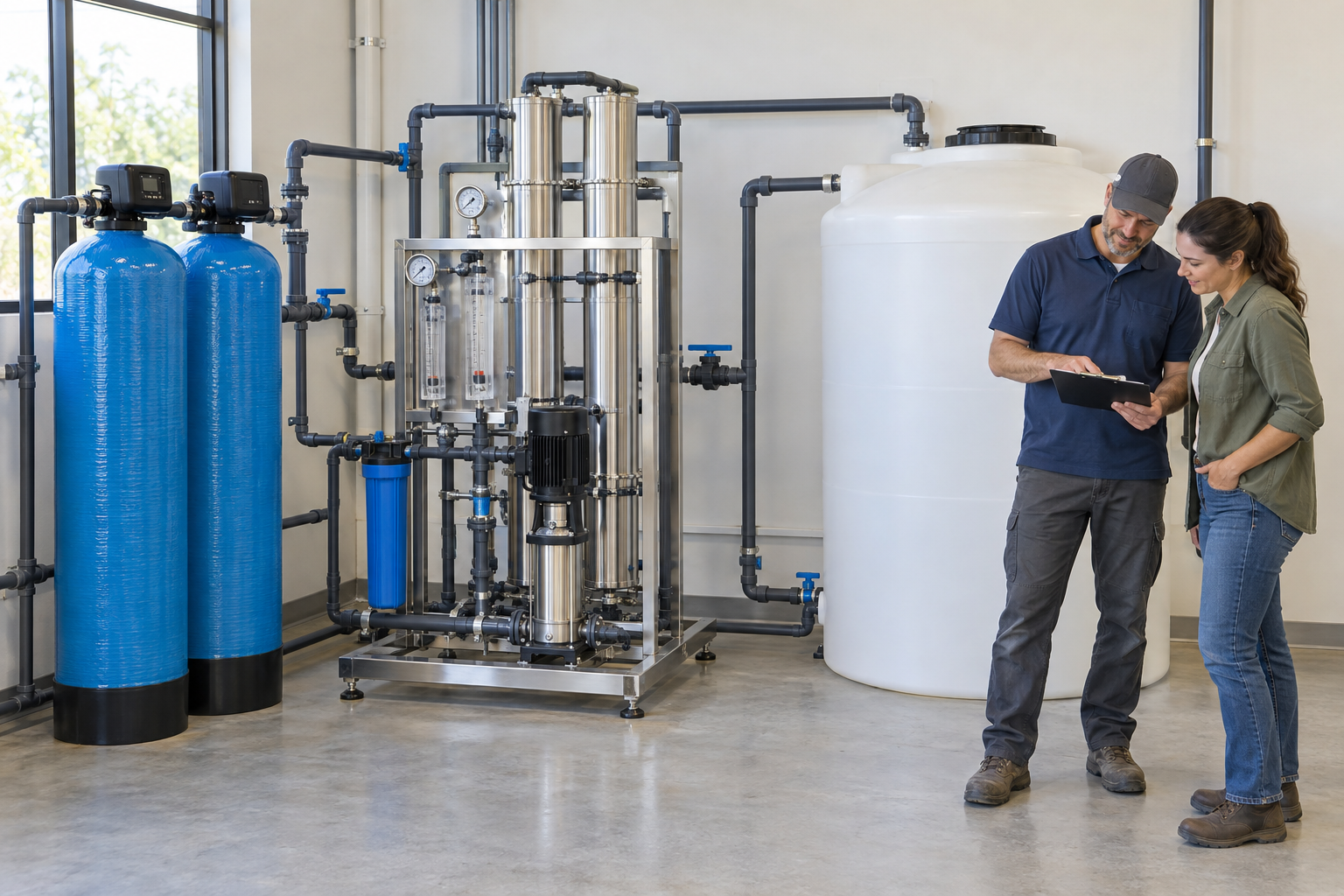
Looking for a water purifier machine for business? Before comparing prices, decide whether you need treated water for your own operations or a complete system for selling drinking water.
A small water-refilling shop, a sachet-water business, a restaurant and a food-processing workshop may all need cleaner water. However, their equipment requirements can be very different.
Quick answer: The right commercial water purifier depends on your source water, intended use, daily demand and required final water quality. A drinking-water business may also need hygienic storage, disinfection, filling and packaging equipment. Reverse osmosis (RO) is an option when dissolved contaminants need to be reduced, but it is not necessary for every water source.
What Kind of Water Business Are You Planning?
Start by identifying what your customers will buy or how your company will use the treated water. This determines the equipment needed after purification.
| Business Type | Typical Equipment Considerations |
|---|---|
| Water refill shop | Suitable treatment, hygienic storage, container cleaning, filling and disinfection |
| Sachet-water business | Water treatment, treated-water storage, sachet filling and sealing, packaging hygiene |
| Bottled-water business | Water treatment, bottle rinsing, filling, capping, labeling and quality control |
| Hotel or restaurant | Targeted drinking or process-water treatment, storage and distribution |
| Small factory | Treatment designed around process-specific water-quality requirements |
These are typical equipment groups, not fixed packages. Local regulations, product requirements and the water source determine what your business must actually install.
Is a Water Purifier the Same as a Filling Machine?
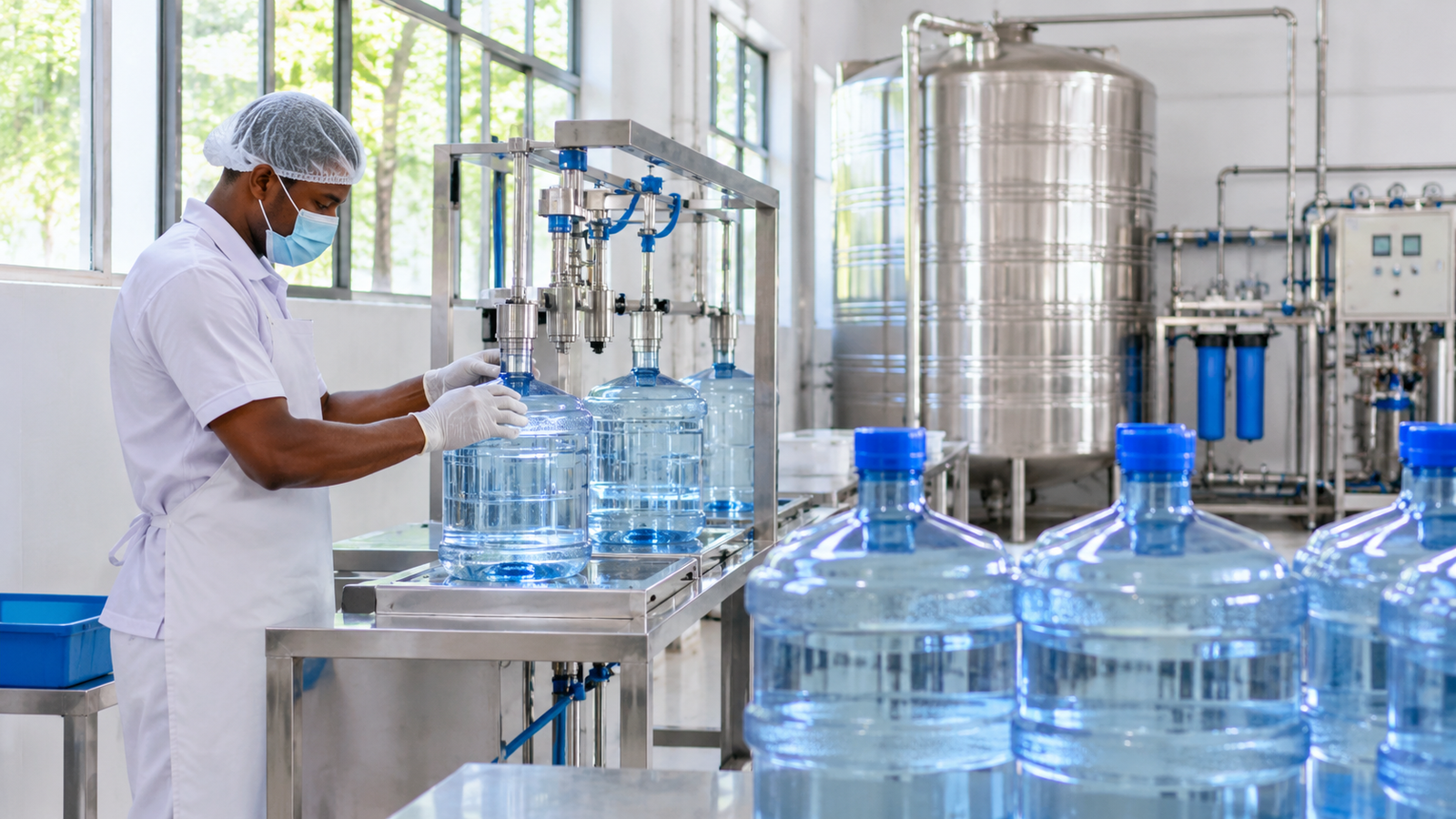
No. A water purifier treats the incoming water. A filling machine transfers treated water into bottles, jars or sachets under suitable hygienic conditions.
A reverse osmosis system does not automatically include disinfection, treated-water storage or packaging. Likewise, buying a filling machine does not mean that the water entering it is suitable for drinking.
For a drinking-water business, the treatment and packaging stages must be designed as one coordinated process, even when supplied as separate machines.
Do You Need Reverse Osmosis?
Not always. The appropriate treatment process depends on what is present in the source water and what the finished water must meet.
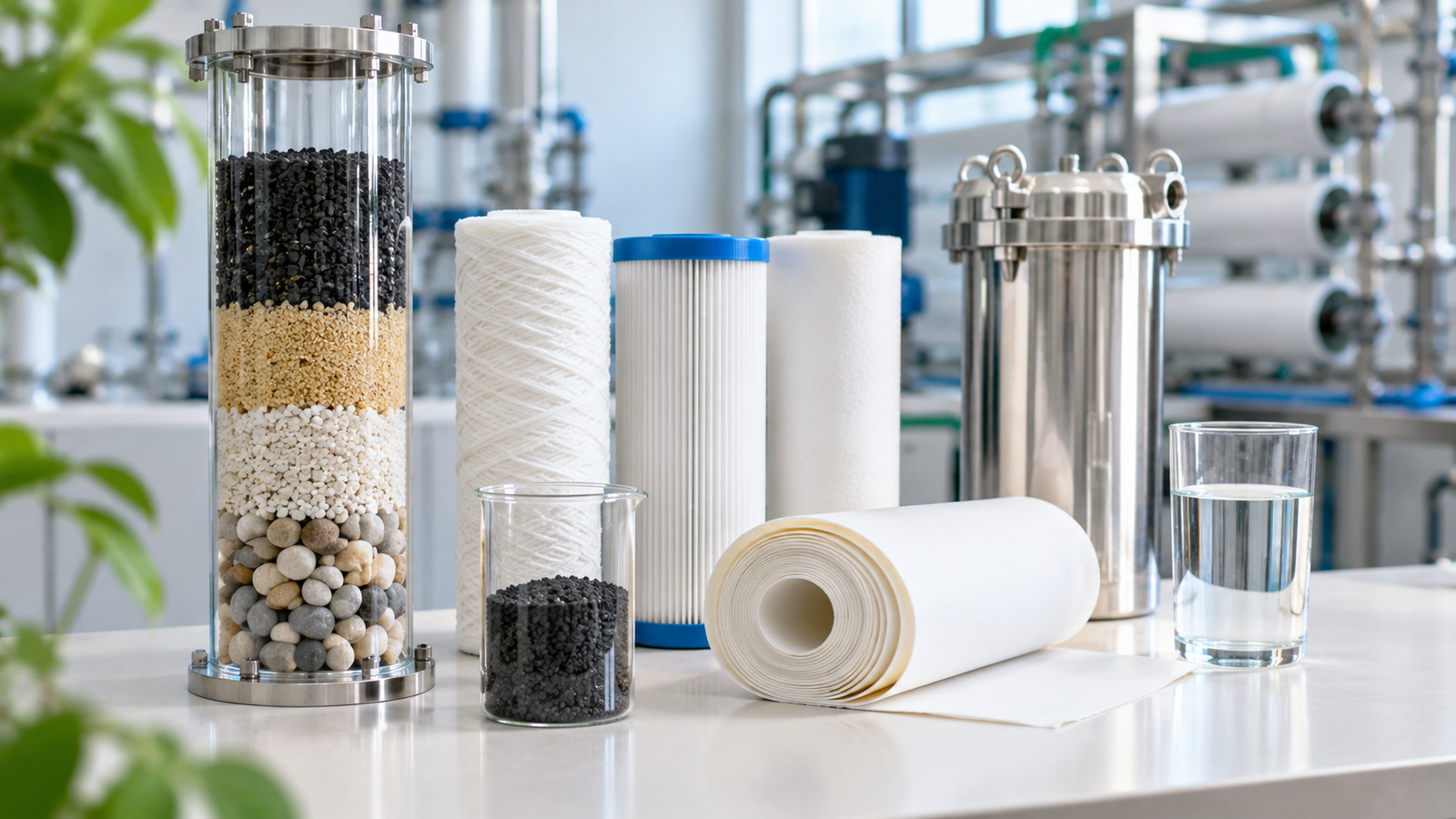
- Sediment or turbidity: Suitable filtration may address suspended particles.
- Hardness: Softening or other scale-control methods may be appropriate, depending on the objective.
- Iron and manganese: Specific removal processes may be needed before downstream treatment.
- Dissolved salts: RO may be appropriate when salinity or particular dissolved contaminants need to be reduced.
- Microbiological contamination: Validated disinfection, hygienic storage and appropriate monitoring are essential.
Even when RO is installed, finished-water safety must be verified against the applicable drinking-water requirements. A low TDS reading alone does not establish that water is safe to sell.
How Much Water Should Your Machine Produce?
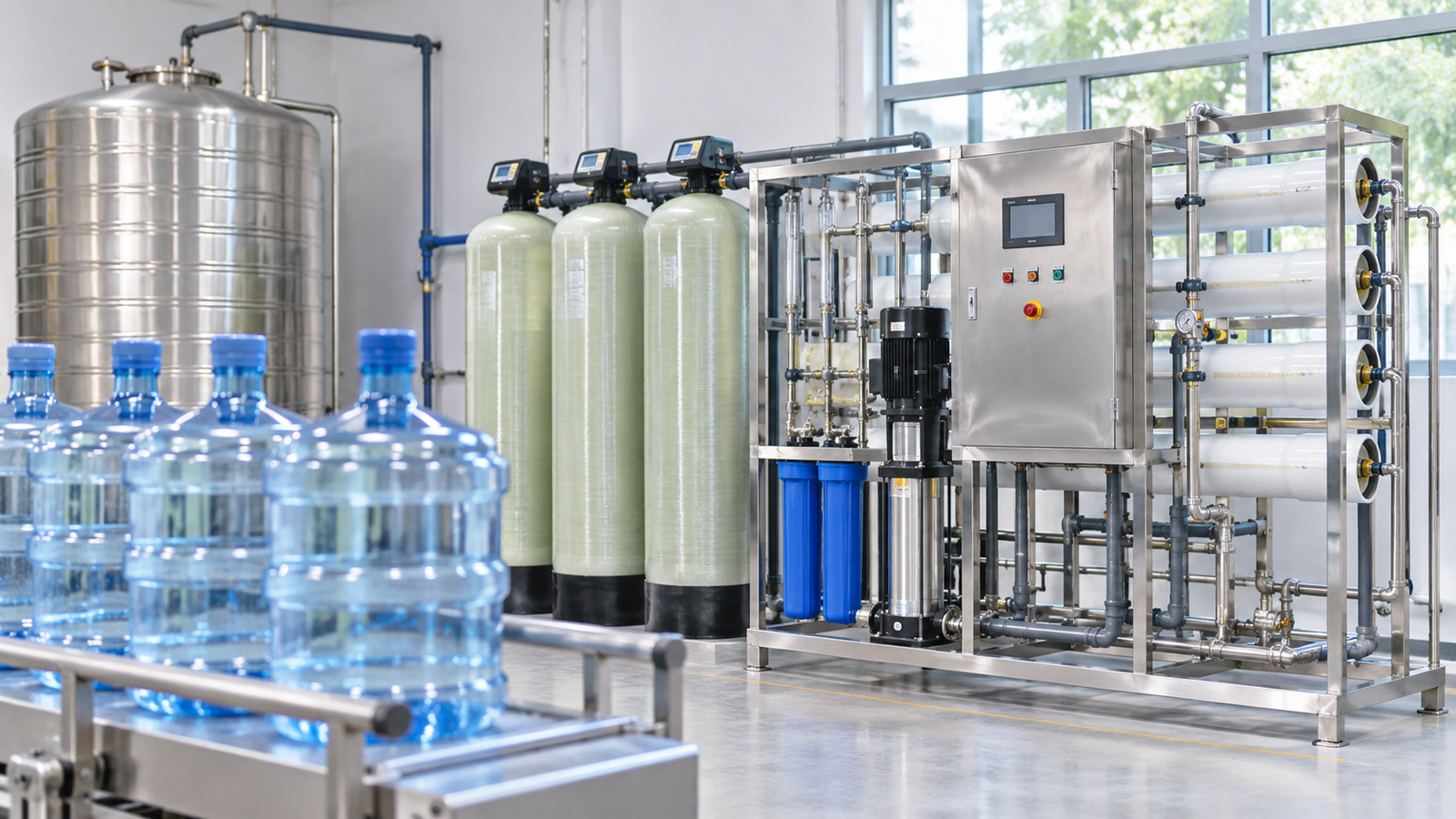
Commercial water purification equipment should be sized using daily demand and available operating time, rather than choosing the largest model within your budget.
For example, if a business expects to sell 4000 liters of treated water per day and the purification system can operate for eight productive hours, the minimum average output is 500 L/hour before allowing for downtime and operating margins.
Daily water demand / productive operating hours = required average hourly output.
4000 L/day / 8 hours = 500 L/hour.
The suitable nominal equipment capacity must then be checked against feed-water salinity, temperature, membrane performance, filling schedules and storage requirements.
Comparing Common Commercial RO Capacities
| Nominal RO Capacity | Output in 8 Hours | Planning Consideration |
|---|---|---|
| 250 L/hour | 2000 L | Limited daily demand or longer production windows |
| 500 L/hour | 4000 L | Small water businesses and commercial users |
| 1000 L/hour | 8000 L | Growing operations or multiple demand points |
| 2000 L/hour | 16000 L | Higher daily demand and shorter production windows |
| 3000 L/hour | 24000 L | Larger commercial operations |
| 5000 L/hour | 40000 L | Higher-volume production requirements |
All values are theoretical outputs at continuous nominal capacity. They do not represent guaranteed daily production under every feed-water or site condition.
Why Water Source Matters More Than the Machine Label
Two businesses may both need a 1000 L/hour purifier, but one uses municipal water while the other uses a borehole with high hardness, iron or dissolved salts.
Their equipment should not automatically have the same pretreatment configuration.
For example, a borehole with elevated iron may need an appropriate iron-removal process before the RO membranes. High hardness can also increase scaling potential and change the recovery target or chemical treatment requirements.
A proper design considers water analysis, membrane-feed limits and the required final water quality. TDS alone is not sufficient to select the complete system.
What Does a Water Purification Business Really Cost?
The price of the purifier is only one part of the business investment. A useful budget should separate equipment purchases, site preparation and recurring expenses.
| Cost Group | Items to Include |
|---|---|
| Water treatment | Pretreatment, RO if needed, disinfection and controls |
| Storage and distribution | Feed tank, hygienic treated-water tank, transfer pumps and piping |
| Packaging | Filling, rinsing, sealing, capping, containers and consumables |
| Site preparation | Building, drainage, electrical supply, installation and testing |
| Import and delivery | Freight, insurance, customs charges and local transport |
| Ongoing operations | Electricity, feed water, labor, filters, chemicals, membrane maintenance and packaging |
| Compliance | Required permits, laboratory testing and applicable product-quality controls |
A low-priced purification machine is not necessarily a low-cost business. An incomplete equipment package can require additional spending before the business can operate.
Why the Purifier and Filling Machine Must Be Sized Together
Consider a business using a sachet filling machine. Its rated packaging capacity does not directly determine the necessary RO capacity.
Suppose a filling machine operates at 2000 sachets per hour and each sachet contains 500 mL. Its theoretical packaging demand is 1000 liters per hour.
If the purifier produces only 500 L/hour, a treated-water buffer tank may allow short filling runs, but the business cannot maintain that packaging rate indefinitely without enough stored water or additional production time.
Calculate daily packaging volume first, then coordinate purification capacity, usable hygienic storage and the filling schedule.
What Should You Check Before Buying a Water Purifier Machine?
Before placing an order, ask suppliers for a clear design basis and a complete equipment list. Comparing only the machine’s price and nominal capacity can be misleading.
- Source water: Is the equipment designed for your actual municipal, borehole or other feed water?
- Water analysis: Have the relevant chemical and microbiological parameters been reviewed?
- Finished-water quality: Are the treatment targets and applicable standards clearly identified?
- Production capacity: What output can be expected under the specified site conditions?
- Scope of supply: Which pretreatment, storage, disinfection and filling components are included?
- Electricity and installation: Do voltage, frequency, available power, space and drainage meet the system requirements?
- Factory testing: What test records and operating measurements will be supplied before shipment?
- Consumables and support: Can replacement filters, membranes and critical spare parts be obtained when needed?
Can You Start Small and Expand Later?
In some cases, yes. A business can begin with a smaller purification system and expand as demand becomes more predictable. However, future expansion should be considered during the initial equipment and site planning.
Available space, electrical capacity, feed-water supply, pretreatment sizing and storage arrangements may limit how easily the system can be enlarged.
For a startup, the sensible approach is to select enough capacity to meet realistic demand while avoiding equipment that is unnecessarily expensive or difficult to maintain.
What Maintenance Will a Small Business Need?
Maintenance requirements vary by treatment process and water source. A commercial RO system typically requires attention to cartridge filters, pretreatment media, chemical dosing where installed, pump operation, membrane performance and water-quality monitoring.
For a drinking-water business, cleaning and sanitation of tanks, filling equipment, containers and contact surfaces are equally important.
Before buying, confirm who will perform routine maintenance, what spare parts should be kept locally and what technical support is available when problems occur.
Choose the Business Process Before the Machine
A water purifier machine is one component of a working business. The best equipment choice starts with the water you have, the water quality you need, and how the treated water will be used or sold.
For many small businesses, the critical decisions are whether RO is necessary, how much treated water must be produced, what equipment is required after purification and whether the complete process can be maintained locally.
Answering these questions before comparing quotations can prevent unnecessary investment and reduce the risk of buying an incomplete or unsuitable system.
Planning a Water Purification Business?
AquaOxy supplies compact commercial RO systems from 250 to 5000 L/hour and helps customers evaluate suitable treatment configurations based on water source, application and operating conditions.
Whether you are planning a refill shop, sachet-water operation, bottled-water business or water treatment system for your facility, share the information you already have:
- Your country and intended business application
- Your water source and any available water analysis
- Your expected daily water demand
- Your required packaging format, if selling drinking water
- Your available electrical supply and operating hours
We can review the treatment requirements and discuss which purification, storage and related equipment should be considered for your project.
Discuss Your Water Purification Project