Water filtration equipment plays an important role in commercial and industrial water treatment. But not every filter treats the same contaminants, and installing more filters does not necessarily produce better water.
A business using municipal water may need particulate filtration and chlorine control. A borehole-water user may need iron removal or softening. Another facility may require reverse osmosis to reduce dissolved salts.
The correct equipment depends on what is present in the water and what the treated water must be used for.
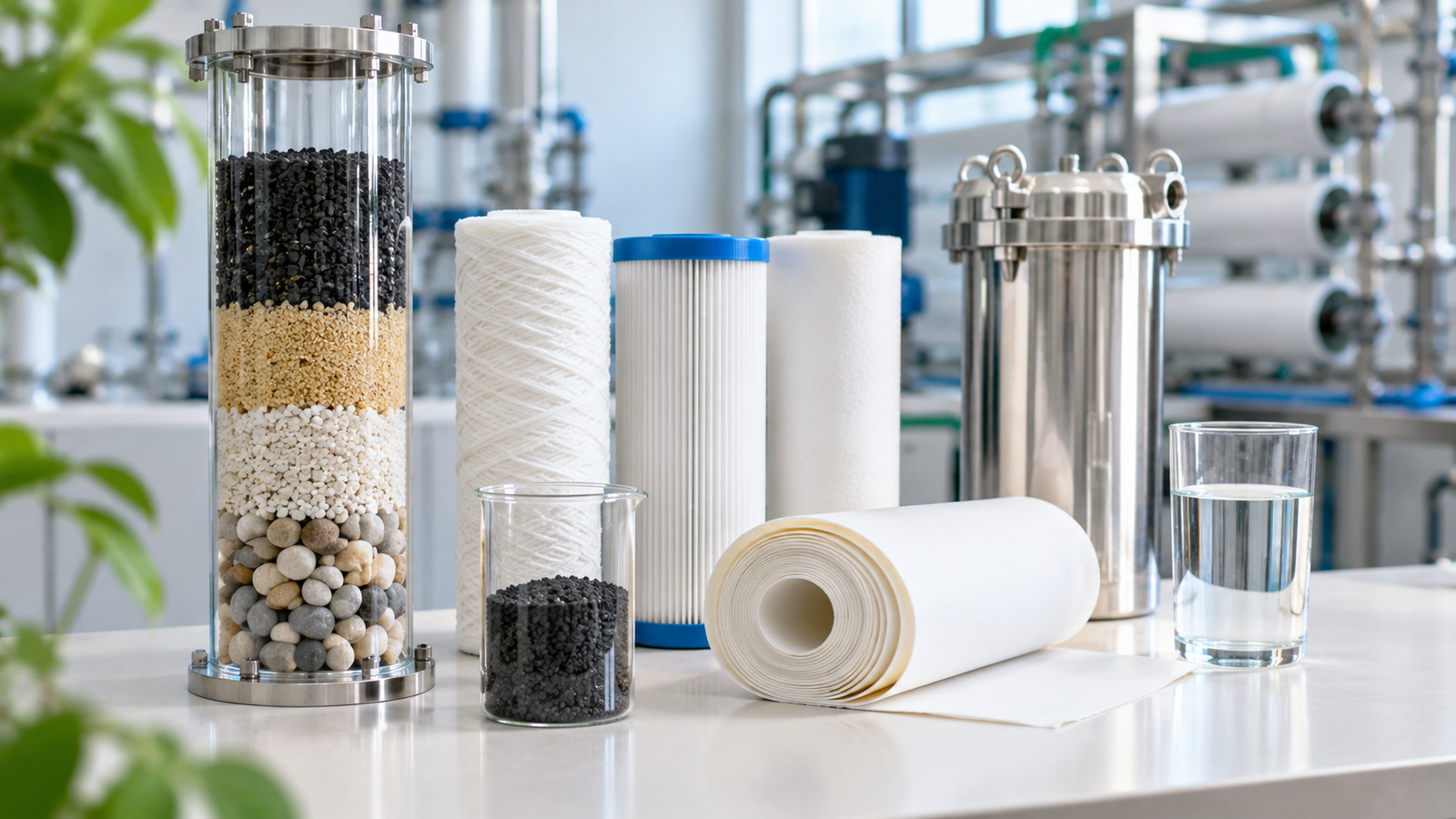
Quick answer: Commercial water filtration equipment includes media filters, activated carbon filters, cartridge and bag filters, and membrane filtration systems. Each technology addresses different water-quality problems. Conventional filtration primarily controls particles or specific contaminants, while reverse osmosis is used when dissolved salts and certain dissolved substances must be reduced. The best equipment combination should be selected from water analysis and the intended application.
What Is Water Filtration Equipment?
Water filtration equipment uses a physical barrier, filter media or other separation mechanism to remove selected contaminants from water.
Some filters capture suspended particles such as sand, rust and sediment. Others use specialized media to adsorb or chemically transform specific substances before they are removed.
Membrane processes offer additional separation capabilities. Depending on the membrane type, they may remove fine particles, colloids, microorganisms or dissolved substances.
It is important to understand that water filtration is not one single process. The word “filter” describes a broad group of technologies with different functions and operating requirements.
Why Does the Water Source Matter?
Consider three businesses that all want cleaner water:
1. A Business Using Municipal Water
The incoming water may already meet local drinking-water standards, but the business could need additional treatment for its particular application. Sediment removal, activated carbon or other suitable treatment may be considered depending on the actual problem.
2. A Business Using Borehole Water
Groundwater can contain hardness, iron, manganese, dissolved salts or other constituents that affect treatment selection. A conventional sediment filter alone cannot address every one of these conditions.
3. A Business Requiring Low-Conductivity Water
For some manufacturing and process-water applications, conventional filtration may remove particles but leave dissolved minerals largely unchanged. Reverse osmosis or further purification may be required to achieve the specified water quality.
These situations illustrate why selecting equipment before examining the water source can lead to unnecessary components or incomplete treatment.
Filtration Is Not the Same as Complete Water Purification
A water filter may improve certain parameters without making the water suitable for every intended use.
For example, clearer water does not necessarily have lower dissolved salt content. Similarly, low conductivity does not prove that water is microbiologically safe.
For drinking-water applications, treatment should be evaluated as a complete process, including relevant contaminant removal, disinfection, hygienic storage and final water-quality verification.
Common Types of Commercial Water Filtration Equipment
Different filtration technologies solve different problems. Understanding their capabilities and limitations is the first step in selecting a reliable treatment system.
| Equipment | Main Function | Important Limitation |
|---|---|---|
| Sand / Multimedia Filter | Reduces suspended solids and turbidity | Does not substantially remove dissolved salts |
| Activated Carbon Filter | Adsorbs certain organics and removes free chlorine under suitable conditions | Not a general solution for hardness or TDS |
| Cartridge / Bag Filter | Captures particles according to element rating | Not a substitute for dissolved-contaminant treatment |
| Specialized Iron / Manganese Filter | Removes iron or manganese under suitable chemical and operating conditions | Requires water analysis and appropriate process conditions |
| Ultrafiltration (UF) | Controls fine particles, colloids and microorganisms according to membrane performance | Does not normally provide significant dissolved-salt removal |
| Reverse Osmosis (RO) | Reduces dissolved salts and many other dissolved contaminants | Needs suitable pretreatment, pressure and concentrate management |
Water softening by ion exchange and ultraviolet disinfection are also common parts of treatment systems, although neither should be confused with conventional particulate filtration.
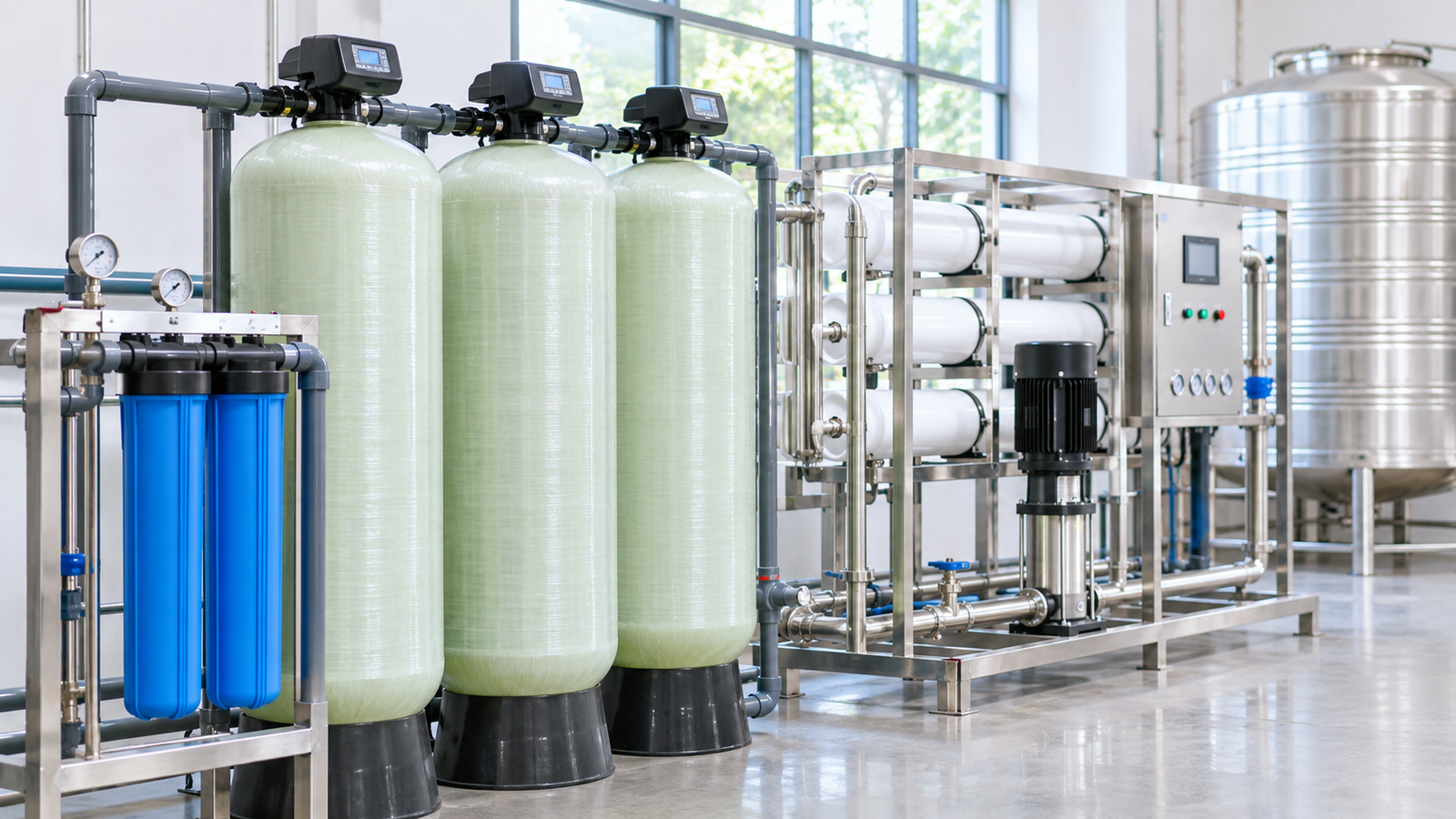
When Is a Sand or Multimedia Filter Enough?
Media filtration may be appropriate when the main objective is reducing suspended particles or turbidity, provided other water-quality requirements are already satisfied.
It is also frequently used as pretreatment before more sensitive equipment, including cartridge filtration and RO membranes.
Filter selection depends on particle loading, required flow, filtration rate, backwash requirements and the quality of water needed downstream.
A sand filter should not be expected to remove dissolved salts, fluoride, nitrate or hardness simply because the water looks clearer after treatment.
What Does Activated Carbon Actually Do?
Activated carbon is widely used for adsorption of selected organic compounds, taste and odor improvement, and removal of free chlorine under suitable operating conditions.
In RO pretreatment, dechlorination is particularly important when the selected membrane is sensitive to oxidants.
However, removal performance depends on carbon type, contact time, water chemistry, loading and maintenance. Chloramine removal, for example, may require a specifically designed catalytic carbon process or another validated approach.
Activated carbon does not provide a general solution for high TDS or water hardness.
What Is the Role of Cartridge Filtration?
Cartridge filters are often used as a final particulate barrier before RO equipment. They help capture particles that may escape upstream pretreatment or enter the pipeline before the membranes.
Selection should consider the filter’s actual rating, flow capacity, pressure drop, housing configuration and replacement requirements.
A cartridge filter alone cannot correct poor upstream iron removal, excessive scaling potential or dissolved-salt contamination.
When Should You Consider Reverse Osmosis?
RO becomes relevant when the water-quality objective includes substantial reduction of dissolved salts or particular dissolved substances that conventional filtration cannot adequately remove.
For example, groundwater can appear visually clear while containing elevated salinity. Adding more sand and carbon filters will not reliably solve that problem.
Reverse osmosis uses a membrane separation process and produces both treated water and concentrate. Its design must consider salinity, membrane pressure, scaling, recovery and pretreatment requirements.
RO is not automatically necessary for every business. The decision should be based on specific water-quality targets rather than equipment popularity.
How Do You Choose the Right Water Filtration Equipment?
Instead of starting with a list of machines, begin with the water-quality problem and the result that the treatment system must achieve.
Step 1: Identify the Water Source
Confirm whether the water comes from a municipal supply, borehole, surface-water source or another source. Water quality may vary over time, particularly where groundwater or surface water is involved.
Step 2: Define the Required Water Quality
Drinking water, food processing, equipment washing and industrial production can have different requirements. A treatment system should be designed around the applicable limits for the actual use.
Step 3: Obtain a Representative Water Analysis
Depending on the source, useful parameters may include turbidity, TDS, conductivity, pH, hardness, iron, manganese, alkalinity, silica, chlorine and microbiological indicators.
Additional tests may be required for particular contaminants or industrial applications.
Step 4: Select the Treatment Processes
Choose equipment according to the contaminants that need to be controlled. A process may include media filtration, carbon, iron removal, softening, cartridge filtration, membrane treatment or disinfection as needed.
The treatment stages must work together rather than being added simply because they are commonly found in commercial equipment brochures.
Step 5: Confirm Capacity and Operating Conditions
Check daily water demand, peak consumption, productive operating hours, feed-water availability, pressure, electrical supply, storage and discharge arrangements.
For RO applications, AquaOxy focuses on compact commercial systems from 250 to 5000 L/hour. Actual system output and configuration must be checked under the specified water-quality and operating conditions.
Three Practical Examples of Equipment Selection
The following examples illustrate how the same general request for “water filtration equipment” can lead to different treatment approaches.
| Water Problem | Potential Treatment Direction | What Must Be Verified |
|---|---|---|
| Turbid water with low dissolved-salt content | Suitable particulate filtration, followed by disinfection if required | Particle loading, microbial safety and the final use |
| Clear water with elevated TDS | Consider RO or another appropriate desalting process | Complete chemistry, target quality and membrane design |
| Borehole water with iron, hardness and elevated TDS | Evaluate iron removal, scale control and RO as an integrated system | Full analysis, pretreatment performance and recovery limits |
These are conceptual examples, not final engineering designs. No equipment configuration should be approved solely from the brief descriptions above.
What Should You Compare in Equipment Quotations?
When comparing suppliers, it is important to examine the scope and expected treatment performance, not just the filter tank diameter or the number of filtration stages.
- Design basis: Which water-quality data and operating conditions were used?
- Contaminant removal: What does each proposed filtration stage actually achieve?
- Flow capacity: Is the equipment sized for the required operating flow?
- Pressure loss: Has the effect of filtration equipment on available pressure been considered?
- Cleaning and backwash: What water, drainage and maintenance arrangements are required?
- Materials: Are the vessels, valves, seals and piping compatible with the water chemistry?
- Consumables: What media, cartridges or membranes require replacement?
- Verification: What testing and acceptance information will be provided?
What Is the Most Common Buying Mistake?
One of the most costly mistakes is assuming that more filtration stages automatically mean better water quality.
A three-stage system designed around the actual contaminants may be more effective and easier to maintain than a larger system assembled from unnecessary or unsuitable components.
Likewise, a system that removes suspended solids effectively may still fail if the true problem is dissolved salinity.
The goal is to match each treatment stage to a clear technical purpose.
Choose the Treatment Process Before the Equipment
Good water treatment begins with understanding the source water, the required final quality and the conditions under which the system must operate.
Media filters, carbon filters, cartridge filters and RO membranes each have useful roles. The challenge is combining them correctly and avoiding components that do not solve the actual problem.
For businesses without an in-house water treatment team, a clear design basis and an understandable equipment quotation are often more valuable than a long list of technical features.
Not Sure Which Filtration Equipment You Need?
AquaOxy helps small commercial and industrial customers evaluate water treatment requirements, with compact RO systems as its core offering.
If your project involves municipal water, borehole water or brackish water, share the available information:
- Water source and water test report
- Required treated-water quality and intended use
- Daily demand and operating hours
- Installation country and electrical supply
We can help review whether conventional filtration, additional pretreatment or an RO-based solution should be considered for your application.
Discuss Your Water Treatment RequirementsFurther technical reading: U.S. EPA — WaterSense at Work: Water Purification.