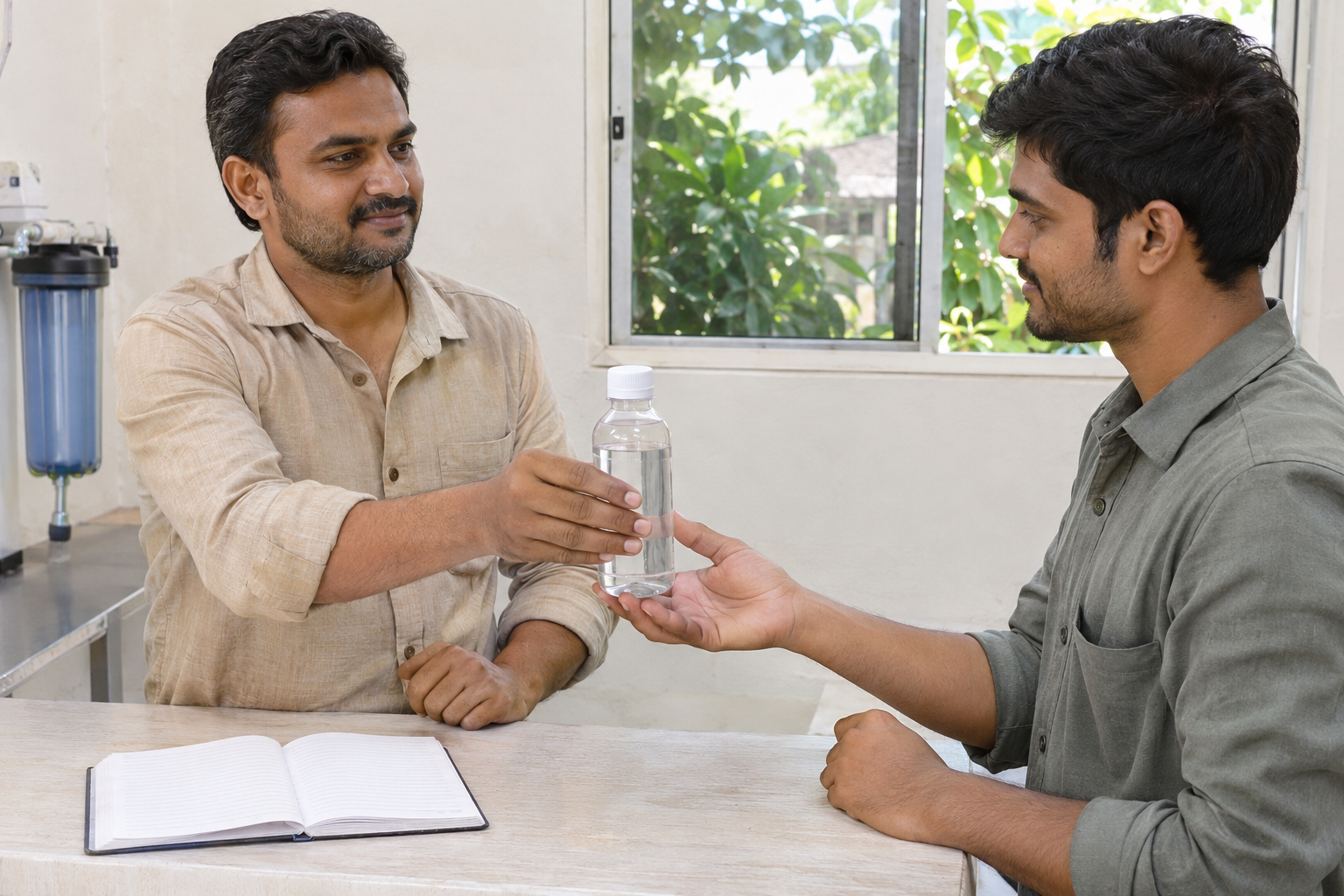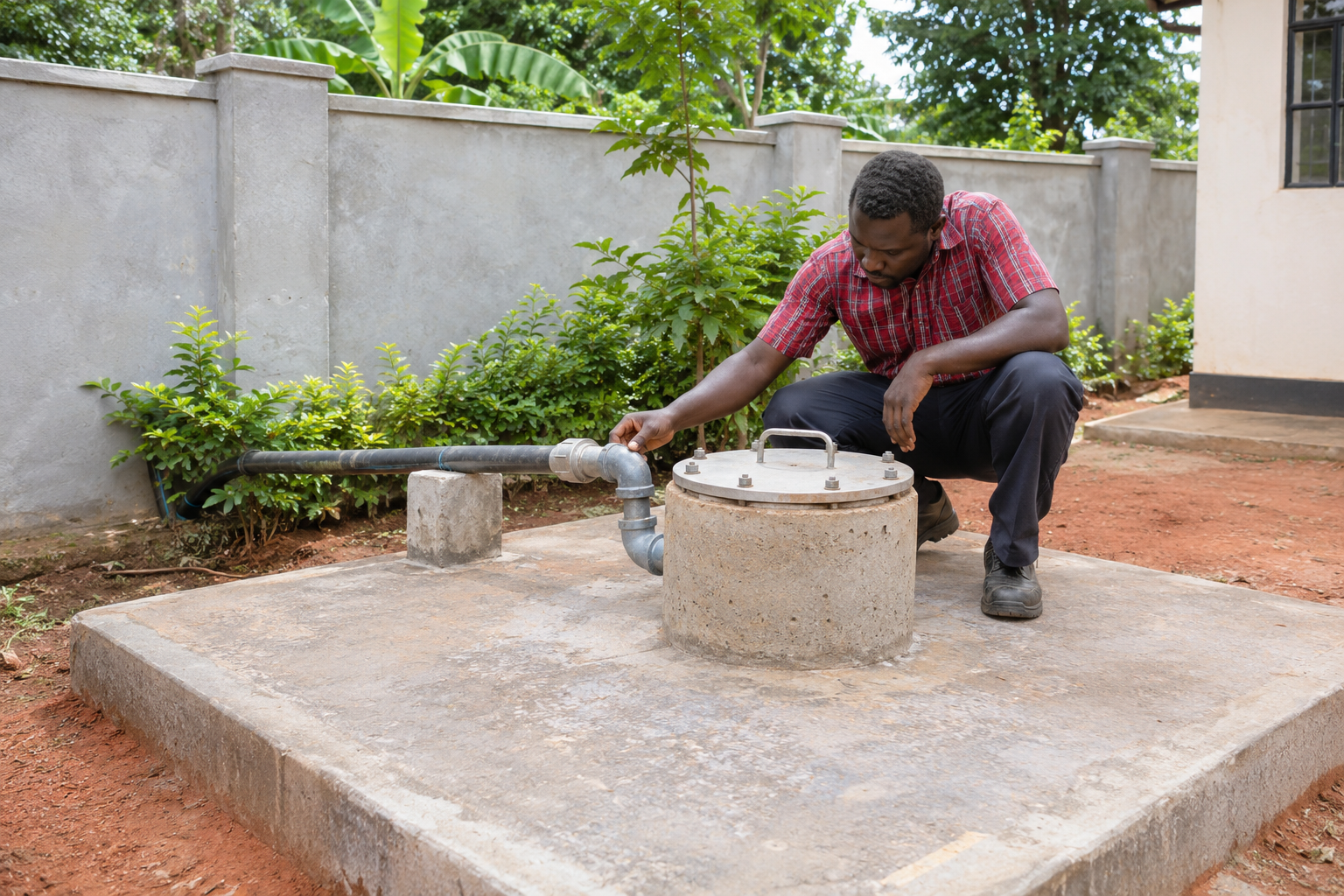
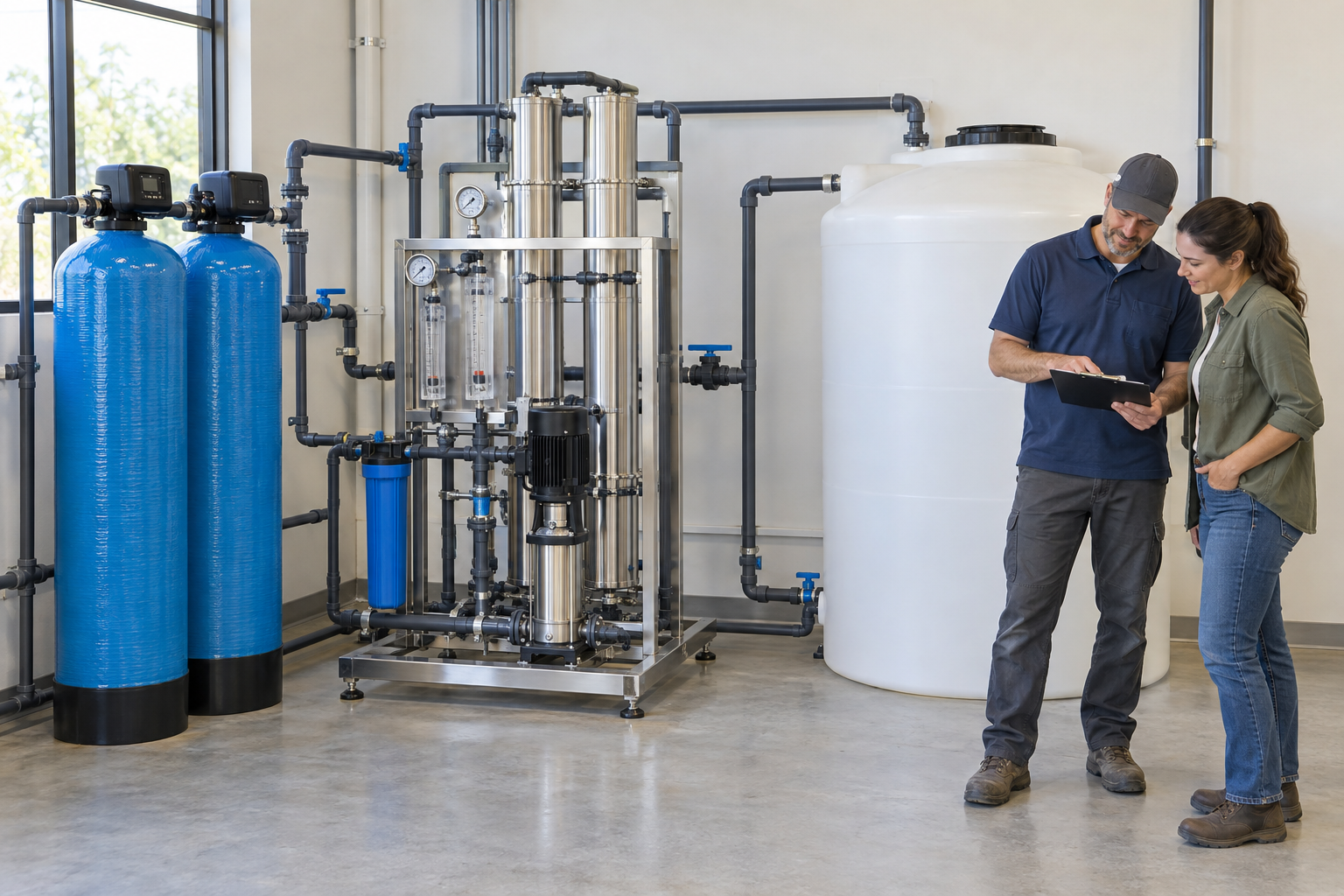
To calculate the RO capacity your business needs, divide your daily treated water requirement by the effective production hours available each day. Then check actual feed water conditions, storage, and peak demand before choosing a model.
For example, a business needing 5,000 litres per day with five effective production hours requires an average output of 1,000 L/hour. This calculation is a starting point. The supplier still needs to confirm performance under your site conditions.
This guide explains how to size a small commercial reverse osmosis system from 250 to 5,000 L/hour.
What Does RO Production Capacity Mean?
RO production capacity normally means the amount of treated water, also called permeate, produced per hour under specified conditions.
A system rated at 1,000 L/hour is intended to produce 1,000 litres of treated water per hour under those conditions. Confirm that the supplier’s capacity figure refers to treated water output rather than feed water flow.
Keep three different figures separate:
- Production capacity: how many litres the RO system produces per hour.
- Daily demand: how many litres your business needs per day.
- Usable storage: how many litres are available from the tank between its operating levels.
A 2,000-litre storage tank does not mean the RO system produces 2,000 L/hour.
How Much Treated Water Does Your Business Need Each Day?
Calculate the water used by activities that require RO treatment.
For a packaged water business, include water going into saleable packages and additional treated water used for relevant rinsing and cleaning.
For a production business, include product water, process water, and cleaning steps that require the same water quality.
Do not automatically include every water use on the premises. Toilets and some cleaning activities may have different treatment requirements.
Illustrative example: a small sachet water business
- 8,000 sachets per day, each containing 0.5 litres: 4,000 litres.
- Additional treated water for relevant rinsing, cleaning, and losses: an assumed 500 litres.
- Total treated water requirement: 4,500 litres per day.
The 500-litre allowance is an example. Replace it with an estimate based on your equipment and working practices.
Prepare both a normal-day requirement and a busy-day requirement. A monthly average can hide days when production capacity is insufficient.
How Many Hours Can the RO System Actually Produce Water?
Use effective production hours rather than total opening hours.
An eight-hour working day may include preparation, flushing, maintenance, and interruptions to electricity or raw water supply. Some activities may overlap, so use a realistic schedule.
Required average output in L/hour = Daily treated water requirement ÷ Effective production hours.
For a business requiring 4,500 litres per day with six effective production hours:
4,500 ÷ 6 = 750 L/hour.
A system delivering 750 L/hour would meet this calculated requirement without additional time allowance. A 1,000 L/hour system could be a candidate, subject to confirmed site output, storage, and operating arrangements.
For a business requiring 5,000 litres per day, changing the production schedule changes the required output:
- Ten effective hours: 500 L/hour.
- Eight effective hours: 625 L/hour.
- Five effective hours: 1,000 L/hour.
- Four effective hours: 1,250 L/hour.
These figures are arithmetic requirements before design allowances. Discuss flexibility for interruptions and realistic growth with your supplier rather than adding an arbitrary percentage.
Can Storage Help Meet Peak Demand?
A treated water tank can balance steady RO production against short periods of higher consumption.
Suppose your process uses 1,500 litres during one hour while the RO system produces 1,000 litres in that hour. Storage must supply the 500-litre difference, assuming all RO output is available to that process.
This does not mean a nominal 500-litre tank is sufficient. The design must consider usable tank volume, starting water level, control settings, other demand, and any required reserve.
Check whether the tank can refill before the next peak. Storage cannot compensate indefinitely when daily production is lower than daily consumption.
The delivery pump and pipework must also provide the required flow and pressure. Buying a larger RO system alone may not solve low pressure at a filling machine.
For drinking water applications, tank hygiene, cleaning access, and any required disinfection should form part of the design.
Will the System Deliver Its Rated Output at Your Site?
Rated capacity must be considered together with feed water conditions. RO membrane performance is affected by temperature, salinity, pressure, and recovery.
Before ordering, ask the supplier to confirm:
- Expected treated water output for your water analysis.
- Feed water temperature used for the calculation.
- Expected output at the lowest relevant operating temperature.
- Required operating pressure and electrical supply.
- Design recovery and required pretreatment.
- Conditions for the performance acceptance test.
Do not assume that a system rated under one set of conditions will deliver the same output under different conditions.
Also confirm the treated water quality required for your application. Capacity and water quality must be assessed together.
If you have not tested your source water, read What Water Test Do I Need Before Buying an RO System? before finalising the configuration.
How Much Feed Water Will the RO System Need?
An RO system needs more feed water than the treated water it produces. Part of the feed leaves as concentrate, also called reject water.
Recovery is the percentage of RO feed water that becomes treated water.
For a simple RO system without external recycle:
Feed water flow = Treated water flow ÷ Recovery.
For example, a system producing 1,000 L/hour at an assumed 60% recovery needs approximately:
- 1,667 L/hour of feed water.
- 1,000 L/hour of treated water output.
- 667 L/hour of reject water discharge.
Use recovery as a decimal in the calculation: 1,000 ÷ 0.60 ≈ 1,667 L/hour.
The 60% recovery is an illustrative assumption, not a recommendation for every source water.
These figures cover the RO process only. Pretreatment backwashing, softener regeneration, flushing, and cleaning may require additional water.
Ask for a complete system water balance before confirming raw water supply, tank sizes, and drainage.
What Information Should You Send Before Requesting a Quote?
You do not need to choose the final model yourself. Send the supplier enough information to assess a suitable capacity and configuration.
- Installation country and location.
- Intended use of the treated water.
- Normal and busy-day water requirements.
- Effective production hours per day.
- Peak consumption and operating schedule.
- Water source and available test report.
- Seasonal feed water temperature, if known.
- Voltage, phase, and frequency.
- Existing tanks and installation space.
- Realistic expansion plans.
Before buying, check three things:
- Is your demand estimate based on actual use?
- Can the system meet it during available production hours?
- Can storage and delivery equipment support your busiest period?
AquaOxy helps small businesses select RO systems from 250 to 5,000 L/hour based on source water, intended use, and operating conditions.
Contact AquaOxy with your daily water requirement, available production hours, and any water report you already have.