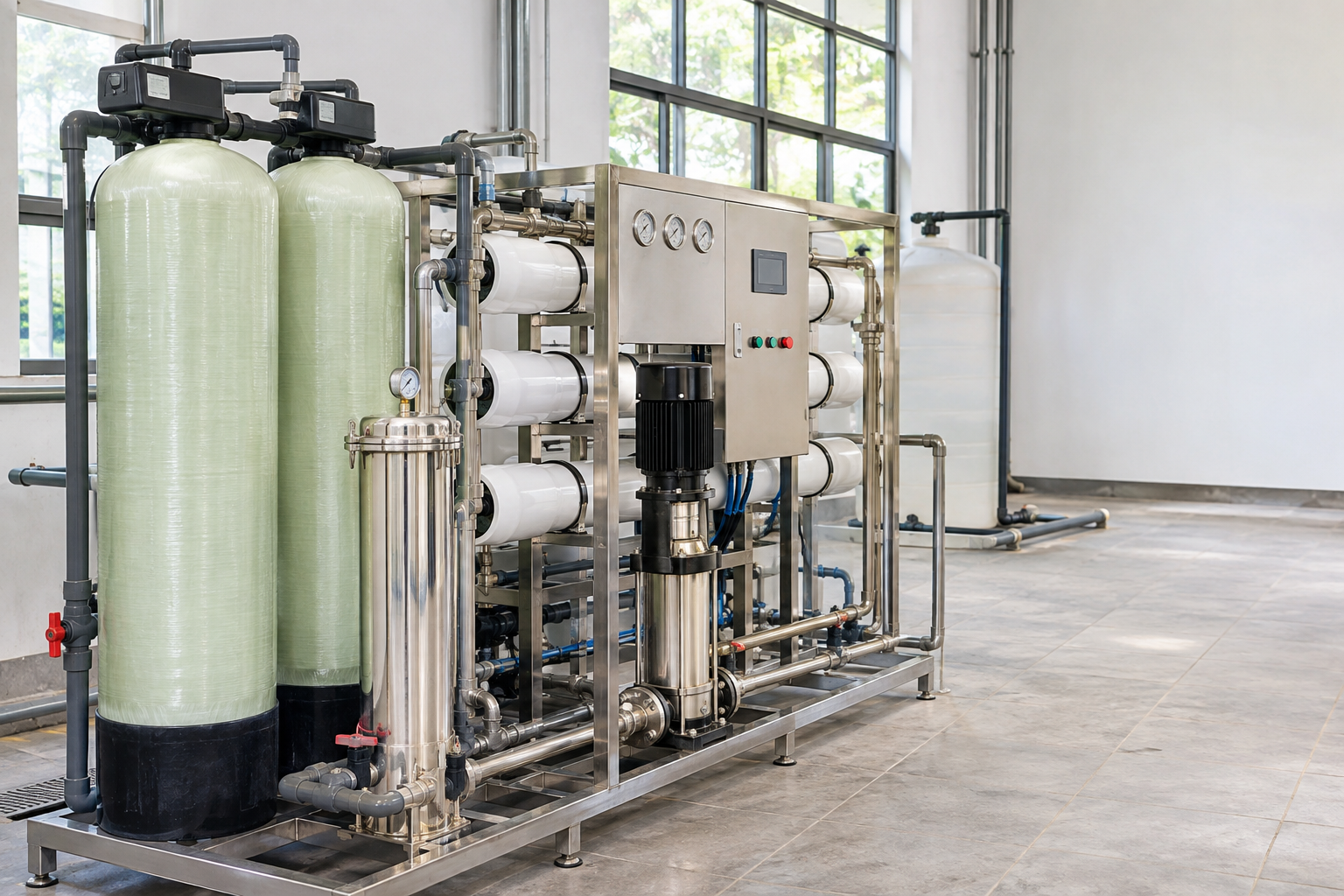

Compared with lower-salinity groundwater, brackish water can require a different RO design to achieve the same treated water output and quality. Membranes, pump duty, pressure-rated components, recovery, and pretreatment must be checked together.
“Borehole water” describes where water comes from. “Brackish water” describes its salinity. A borehole can therefore supply either fresh groundwater or brackish groundwater.
For businesses selecting RO systems from 250 to 5,000 L/hour, the useful question is whether the complete system is designed for the actual water analysis and intended use.
1. Is Borehole Water Always Different from Brackish Water?
No. These descriptions refer to different characteristics and can apply to the same water source.
Water from a coastal borehole may be saline, while another borehole may have lower salinity but significant hardness or iron. Neither source can be fully described by the word “borehole.”
Give the supplier both the source description and the water analysis. If a quotation uses terms such as freshwater, brackish water, or seawater, ask for the actual feed water limits behind that description.
A category name is not a substitute for a stated design range.
2. How Does Higher Salinity Affect RO Production?
Higher salt concentration increases osmotic pressure. With other conditions unchanged, this reduces the effective pressure available to drive water through the membrane.
As a result, equipment producing a particular flow on lower-salinity water may produce less when supplied with more saline water.
The designer must check the pressure and membrane arrangement needed to deliver the required output. Feed temperature and the selected recovery also affect the calculation.
Do not assume that a “1,000 L/hour” label guarantees the same production across different water sources.
Ask the supplier to state:
- Feed analysis and temperature used for selection.
- Expected treated water output and quality.
- Required operating pressure.
- Design recovery and expected feed flow.
- The conditions under which performance will be checked.
3. Is Changing the Membrane and Pump Enough?
A membrane and pump change may form part of an approved configuration, but those changes alone do not establish that an existing system is suitable.
The supplier should verify the complete assembly at the proposed operating conditions.
- Membrane model, quantity, and arrangement.
- Pump flow and pressure at its intended operating point.
- Motor and electrical supply compatibility.
- Pressure and material suitability of vessels, pipework, valves, and fittings.
- Instrument ranges and protective controls.
- Pretreatment, flushing, and cleaning provisions.
Two systems may share a frame and overall appearance while using different components. Conversely, similar-looking components may have different specifications.
For an existing machine, ask its supplier to confirm suitability before changing settings or replacing major components.
4. Does Brackish Water Need Different Pretreatment?
Possibly, but salinity alone does not determine the answer. The analysis must also identify the constituents that influence scaling, fouling, and membrane compatibility.
Lower-salinity groundwater can still require substantial pretreatment. Brackish water should not automatically receive every available treatment stage either.
Ask the supplier to explain:
- Which results justify each pretreatment stage.
- What feed limits must be achieved before RO.
- Which measurements are still missing.
- How pretreatment performance will be verified.
Avoid accepting a configuration solely because it is labelled “for salty water.” It should be connected to the actual report and the proposed operating conditions.
If you are preparing an analysis, read What Water Test Do I Need Before Buying an RO System?
5. Should Brackish Water Use the Same Recovery Rate?
Do not copy a recovery setting from another installation. Increasing recovery concentrates dissolved substances in the remaining feed and reject water, so the proposed value needs a design assessment.
There is no single recovery percentage that suits every brackish water source.
Recovery also changes the raw water and discharge requirements. For a simple system without external recycle, producing 1,000 L/hour at an assumed 50% recovery requires approximately 2,000 L/hour of RO feed and produces 1,000 L/hour of reject water.
At an assumed 40% recovery, the same output requires approximately 2,500 L/hour of RO feed and produces 1,500 L/hour of reject water.
These are illustrative water-balance calculations, not recommended operating settings. Pretreatment and cleaning can add further water demand and discharge.
Before buying, confirm that the source, storage, pumps, and discharge arrangement can support the complete system.
6. What If Salinity Changes During the Year?
Tell the supplier about any measured variation in source water, including changes associated with seasons, pumping, or mixing different supplies.
A single sample may not describe the full operating range. Ask whether additional samples or monitoring are needed before the configuration is confirmed.
Request expected performance over the agreed range, including the combination of higher salinity and lower temperature where relevant.
The proposal should state what happens if the water moves outside that range: which checks are required, whether production must stop, and who should review the system.
Also define treated water requirements for the intended application. A general salt-rejection claim does not replace an agreed product water specification.
7. What Should You Confirm Before Ordering?
Send the water report, source description, daily water requirement, available operating hours, and electrical details. Include any known variation in salinity or temperature.
Review the recommendation with three questions:
- Is the complete system verified for our feed water range and required product water quality?
- Can our site support the proposed pressure, electricity, feed flow, and reject discharge?
- What monitoring and maintenance will keep operation within the agreed limits?
AquaOxy helps small businesses select RO systems from 250 to 5,000 L/hour based on source water, intended use, and operating conditions. Brackish water configurations require assessment against the actual project information.
Contact AquaOxy with your water report, required output, application, and installation details to discuss the information needed for a suitable configuration.