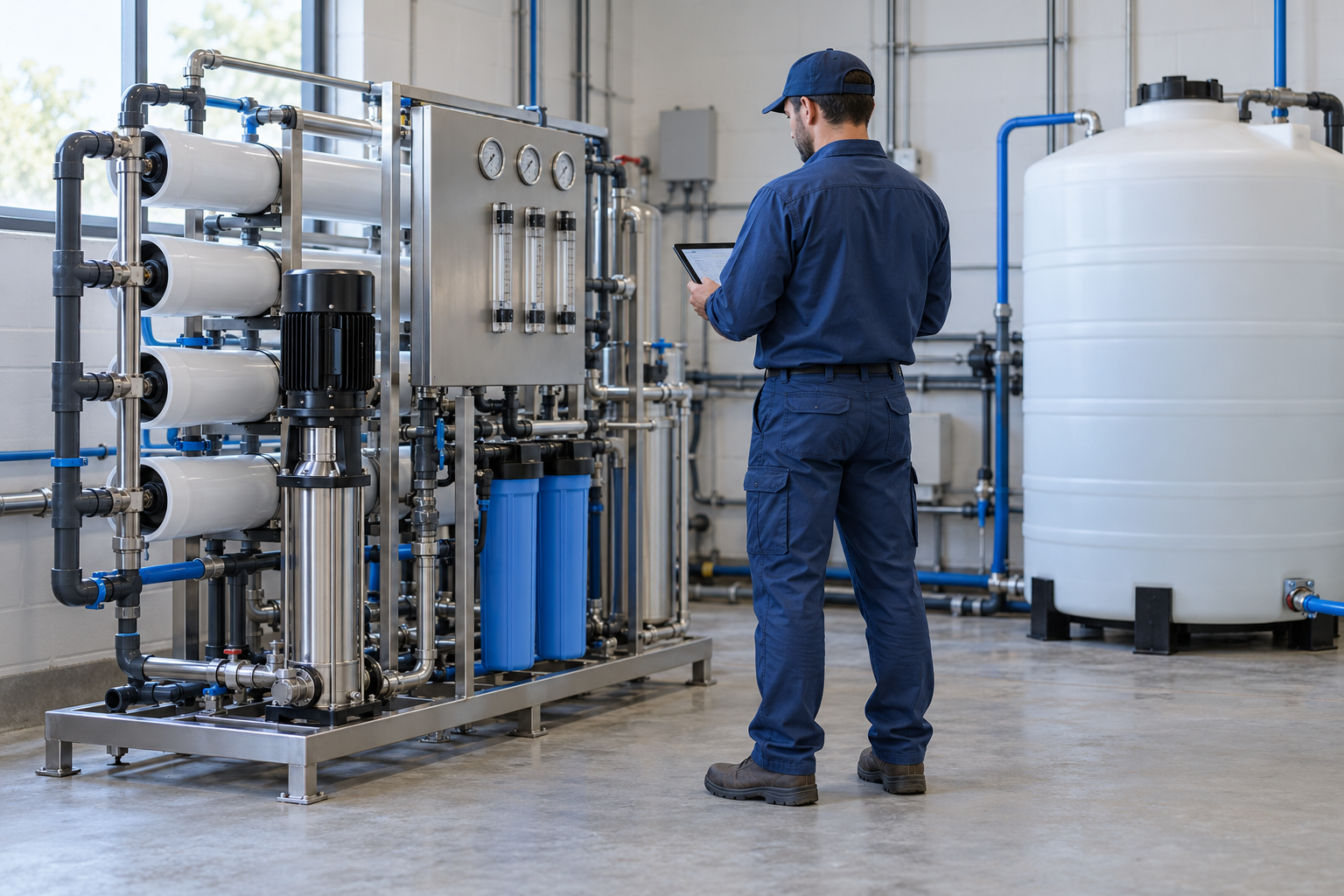

An RO system separates feed water into two streams: permeate, which is the treated water passing through the membranes, and concentrate, also called reject water, which carries away much of the retained dissolved material.
For a simple system operating steadily without recycle or other side streams, feed flow equals permeate flow plus reject flow. Recovery is the percentage of feed water that becomes permeate.
Understanding these relationships helps you interpret equipment capacity, estimate raw water demand, and discuss drainage requirements with your supplier.
1. What Are Feed, Permeate and Reject Water?
Feed water is the water entering the RO process. It may already have passed through pretreatment filters, softening, or other stages.
Permeate is the water that passes through the RO membranes. Suppliers may call it product water or treated water. Its suitability for your application must still be confirmed against the agreed quality requirements.
Concentrate or reject water is the stream leaving the membrane feed side with a higher concentration of retained substances.
Ask your supplier to identify these streams on the equipment layout. Do not identify a pipe’s function only by its colour, diameter, or position.
2. Does a 1,000 L/hour RO System Use Only 1,000 L/hour of Water?
No. The capacity figure normally refers to permeate output under specified conditions. Feed demand is higher because the system also produces reject water.
Consider a simple illustrative operating condition:
- Feed flow: 2,000 L/hour.
- Permeate flow: 1,000 L/hour.
- Reject flow: 1,000 L/hour.
The water balance is 2,000 = 1,000 + 1,000 L/hour.
If the system maintains these flows for five production hours, it uses 10,000 litres of RO feed, produces 5,000 litres of permeate, and discharges 5,000 litres of reject water.
These figures exclude additional water used for pretreatment, flushing, and cleaning. They illustrate a calculation, not a recommended setting.
3. How Do You Calculate RO Recovery?
Recovery (%) = Permeate flow ÷ Feed flow × 100.
Using the example above, recovery is 1,000 ÷ 2,000 × 100 = 50%.
For a simple system without recycle, if permeate and final reject flows are known, feed flow can be calculated by adding them together.
For example, 1,000 L/hour of permeate and 500 L/hour of reject give a calculated feed flow of 1,500 L/hour and recovery of approximately 66.7%.
Do not calculate recovery by dividing permeate flow by reject flow. Recovery compares product water with the water entering the defined process boundary.
Recovery is also different from salt rejection. Recovery describes a water-flow ratio; salt rejection describes a reduction in dissolved salt concentration.
4. How Should You Read the Flowmeters?
First confirm which stream each meter measures and which unit its scale uses.
- L/min means litres per minute.
- L/hour means litres per hour.
- m³/hour means cubic metres per hour.
To convert L/min to L/hour, multiply by 60. A reading of 10 L/min equals 600 L/hour.
To convert m³/hour to L/hour, multiply by 1,000. A reading of 0.5 m³/hour equals 500 L/hour.
Use the same units before adding flows or calculating recovery. Follow the instrument instructions for the correct reading point on the float.
Record readings during stable production rather than startup or flushing. Note operating pressure, temperature, and relevant water-quality readings at the same time.
5. What Changes When the System Has Concentrate Recycle?
Some systems return part of the concentrate to an upstream point. In these arrangements, internal membrane feed flow is different from the fresh feed entering the overall system.
A concentrate meter may measure a stream before it splits into recycle and final discharge. Its reading cannot automatically be treated as the volume sent to drain.
Ask the supplier to identify:
- Fresh feed entering the system.
- Internal recycle flow.
- Permeate leaving the system.
- Final concentrate discharge.
- The boundary used for the quoted recovery.
For a simple steady overall balance with no other inlet or outlet streams, fresh feed still equals permeate plus final concentrate discharge. Internal recycle is not an additional supply of fresh water.
6. Why Is Total Site Water Use Higher Than the RO Calculation?
RO production is only part of the operating cycle. The installation may also use water for filter backwashing, softener regeneration, flushing, cleaning, and application-specific rinsing.
These activities may happen at different times and have different peak flow requirements.
Before confirming the installation, request:
- Normal RO feed, permeate, and final reject flows.
- Estimated additional water use for each operating cycle.
- Required backwash flow and pressure where applicable.
- Expected peak discharge flow.
- Assumptions used for the daily water estimate.
A system’s production recovery and its overall site water efficiency are therefore different measures. Compare proposals using the same calculation boundary.
7. What Should Operators Check Before Changing Flow Settings?
A higher calculated recovery is not automatically a better operating condition. Membrane design includes limits on flow, pressure, and concentration.
Do not close the reject valve simply to reduce discharge or make the recovery number higher. Follow the commissioning settings and adjustment procedure provided for your system.
Before making changes, ask:
- Are we reading the correct meters in matching units during stable production?
- Does the calculation use fresh feed and final discharge, or internal flows?
- Are the proposed settings within the approved limits for this water and equipment?
If readings change unexpectedly, record the conditions and contact the supplier rather than adjusting valves to hide the change.
AquaOxy helps small businesses select and understand RO systems from 250 to 5,000 L/hour based on source water, intended use, and operating conditions.
Contact AquaOxy with your required output, water information, and operating schedule to discuss production capacity, feed demand, and the water balance for a suitable configuration.