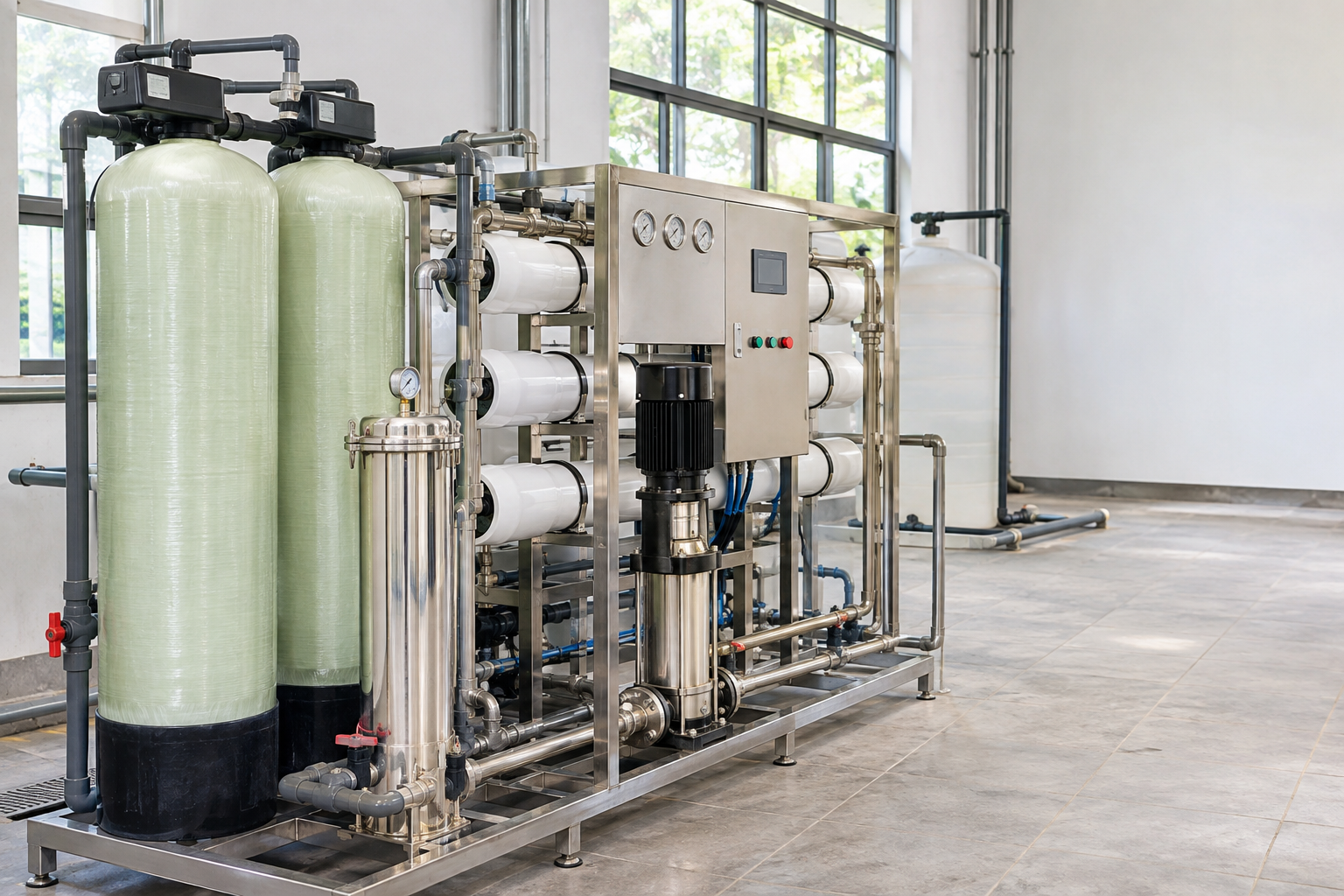

RO membranes and high-pressure pumps should be selected together using the feed water analysis, temperature range, required product water quality, production capacity, and design recovery. The membrane calculation establishes the operating requirements, and the pump must deliver the necessary flow and pressure within its suitable operating range.
Membrane brand, membrane quantity, and motor power are useful specifications, but none of them independently proves that a system will produce the required water at your site.
For businesses comparing RO systems from 250 to 5,000 L/hour, the important evidence is a consistent design supported by clearly stated conditions.
1. What Information Comes Before Membrane and Pump Selection?
Start with the water being treated and the result your business needs.
Give the supplier:
- A representative feed water analysis.
- Expected minimum and maximum feed water temperatures.
- Required treated water output in L/hour.
- The treated water quality required for the application.
- Daily operating hours and supply interruptions.
- Available voltage, phase, and frequency.
The supplier should then assess pretreatment, membrane configuration, recovery, and hydraulic requirements together.
If information is missing, ask which assumptions remain provisional and what must be checked before production.
2. Why Is Membrane Datasheet Output Different from System Output?
A membrane datasheet reports performance under specified test conditions. These include defined feed composition, temperature, pressure, and recovery.
Your installation may operate under different conditions, so adding together the datasheet flow ratings does not establish the actual system capacity.
A system projection should estimate performance using the selected membrane models and the proposed arrangement under your design conditions.
Ask the supplier to distinguish:
- The membrane’s standard test rating.
- The projected system output for your feed water.
- Any allowance for performance changes over time.
- The conditions used for equipment acceptance.
A quotation stating a membrane brand and “1,000 L/hour” should also explain the connection between them.
3. Does Adding More Membranes Always Solve a Capacity Problem?
Membrane quantity matters, but the model and arrangement matter too.
Ask how the elements are distributed across pressure vessels and stages. A statement such as “four membranes” is incomplete without the configuration.
The proposed arrangement should be checked against the membrane manufacturer’s operating guidelines, including flow and recovery limits.
Do not assume that adding elements or substituting a higher-rated model is a direct upgrade. The change should be reviewed against the pump, vessels, pipework, controls, and product water requirements.
For replacement purchases, confirm the complete membrane model and compatibility rather than selecting by physical size alone.
4. Why Is Pump Power Alone Insufficient?
Motor power does not tell you the flow and pressure a pump will deliver in the installed system.
Pump selection requires a duty point: the required flow together with the required head or pressure contribution. The pump curve is used to check that combination.
A pump’s maximum flow and maximum head are generally different endpoints of its performance curve. Do not assume it can deliver both at the same time.
Request:
- The exact pump model and applicable performance curve.
- Required flow and head at the selected duty point.
- Inlet conditions used for selection.
- Motor and power-supply specifications.
- Confirmation of suitability for the liquid and operating range.
A larger motor is not automatically evidence of a better match. Ask how the selected pump serves the calculated requirements.
5. Should Pump Flow Equal RO Product Water Output?
Usually, the high-pressure pump handles more water than the final permeate output because the membrane process also produces concentrate.
For a simple arrangement without concentrate recycle, producing 1,000 L/hour at an assumed 50% recovery requires 2,000 L/hour of RO feed.
This example establishes a water-flow requirement, not a complete pump selection. The required pressure, inlet conditions, losses, and pump curve must still be checked.
Where recycle is included, the flow handled by the high-pressure pump depends on where the return stream enters. Ask for the flow diagram and pump duty rather than guessing from product capacity.
Also distinguish the raw water pump, high-pressure pump, and treated water delivery pump. They serve different duties and should be specified separately.
6. What Else Must Match the Selected Pump and Membranes?
The complete system must support the proposed operating conditions.
Ask the supplier to confirm:
- Pressure ratings and material suitability of vessels, valves, fittings, and pipework.
- Suitable instrument ranges and protective controls.
- Adequate pretreatment flow and feed supply.
- Electrical compatibility at the installation point.
- Flushing and cleaning arrangements.
For a variable-speed drive, generator, or inverter supply, request compatibility confirmation from the relevant suppliers.
If a component is substituted after quotation, ask whether the design and electrical requirements have been rechecked. A similar appearance or power rating is insufficient.
7. What Evidence Should You Request Before Ordering?
You do not need to perform the engineering yourself. Ask for enough documentation to connect your requirements with the selected equipment.
Three questions help assess the proposal:
- What projected output and product quality does this membrane configuration provide under our water conditions?
- Where is the required flow and pressure shown on the selected pump curve?
- How will the assembled system’s performance be checked against the agreed conditions?
Request a configuration list, design assumptions, flow diagram, and agreed testing scope. A factory test should identify the test water and operating conditions so its results can be interpreted correctly.
If you are still preparing the feed water information, read What Water Test Do I Need Before Buying an RO System?
AquaOxy helps small businesses select RO systems from 250 to 5,000 L/hour based on source water, intended use, and operating conditions.
Contact AquaOxy with your water report, required output, product water requirements, and electrical supply details to discuss a suitable membrane and pump configuration.