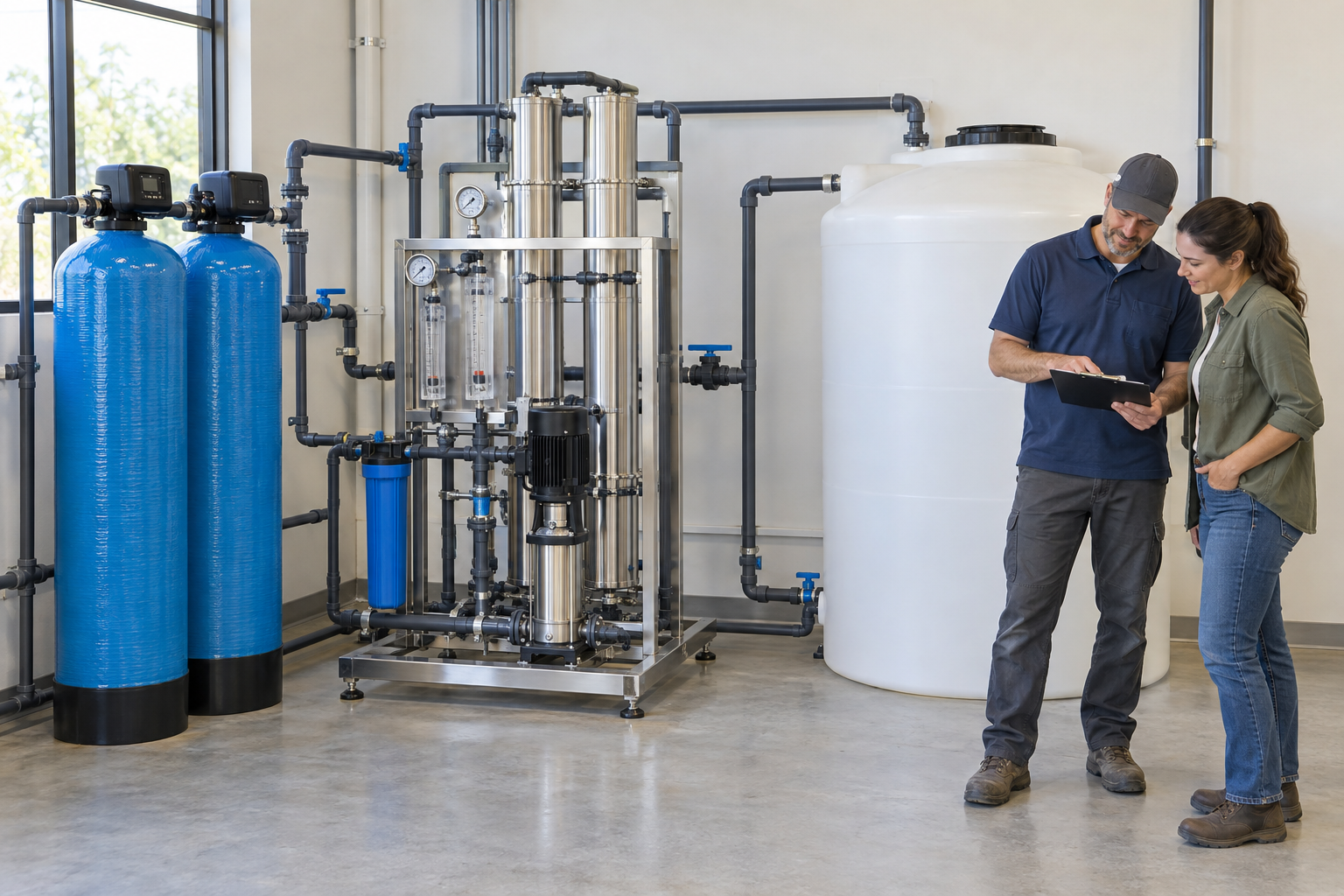

Choose a hotel water treatment system by testing the source water and separating the requirements of drinking water, food preparation, laundry, hot water, and other services. Use those requirements to decide where RO, softening, filtration, or other treatment is justified.
Not every hotel needs reverse osmosis for its entire water supply. A dedicated drinking water system may be sufficient for one property, while saline source water may require a broader treatment arrangement at another.
Before requesting equipment, identify the problem you need to solve: water quality, scale, staining, unreliable supply, or a combination of these.
Does the Whole Hotel Need RO Water?
The answer depends on the source water and the quality required at each point of use.
Where the main supply is otherwise suitable, a dedicated RO system may serve drinking water dispensers, selected kitchen uses, or an on-site drinking water service.
If the source is saline, treatment may need to cover more of the property’s demand. The design should also check the suitability of the finished water for the distribution system and any required post-treatment.
Simply treating the highest possible volume can increase equipment size, feed water demand, storage, and maintenance. Treating too little can leave important uses without suitable water.
Ask for a layout showing which outlets each proposed treatment line will serve. This makes the scope clearer than a quotation describing only a “hotel RO system.”
Separate Guest Water from Laundry, Hot Water and Equipment Needs
Start with a simple list of the hotel’s water uses.
- Guest drinking water and restaurant service.
- Food preparation, ice, and beverage equipment.
- Laundry and dishwashing.
- Showers and hot water systems.
- Pools, spas, irrigation, and other services.
Equipment manufacturers may specify their own inlet water requirements. Obtain these for ice machines, coffee equipment, dishwashers, and water heaters before confirming treatment.
Pools and spas need their own operating and water-quality controls. A source-water treatment unit does not replace those systems.
If different supplies are used, include clear identification and appropriate protection against cross-connections in the plumbing design.
When Is a Softener More Relevant Than RO?
A softener and an RO system perform different functions. Conventional softening reduces hardness, while RO reduces a broader range of dissolved salts.
When the main issue is hardness-related scaling, softening may be part of the solution for selected services. It does not desalinate brackish water or, by itself, establish drinking water suitability.
RO may be appropriate when dissolved salt reduction is required. Its configuration still needs suitable pretreatment and an agreed finished water specification.
Ask the supplier to connect each treatment stage to a measured condition or equipment requirement. Avoid choosing between “softener” and “RO” before defining the problem.
How Much RO Capacity Does a Small Hotel Need?
Room count alone is insufficient. Calculate the demand of the outlets actually connected to the RO supply, using realistic occupancy and service levels.
For a dedicated drinking and kitchen supply, estimate:
- Guest and staff drinking water.
- Restaurant and kitchen demand assigned to the treated supply.
- Ice or beverage equipment consumption.
- Relevant cleaning and rinsing requirements.
Suppose the calculated total is 1,500 litres per day and the RO can produce for six effective hours. The average requirement is 250 L/hour, before allowing for interruptions or other operating flexibility.
This is a sizing example, not a consumption allowance per guest or a recommendation for every hotel. Confirm expected output under the actual feed water conditions.
Peak delivery demand requires a separate check. If a kitchen uses 200 litres in 20 minutes, its average draw during that period is 10 L/min, or 600 L/hour.
A storage tank and delivery pump may support that short peak while RO production continues at a lower rate. Check usable volume, simultaneous demand, pressure, and refill time.
Include Storage and Distribution in the Design
Water quality at the treatment outlet is only one part of a hotel’s water system. Storage, pipework, operating conditions, and maintenance also affect the water reaching guests and staff.
Tell the designer about central hot water, existing tanks, long pipe runs, rarely used rooms, and seasonal closures. These details belong in the property’s water-management assessment.
Installing RO does not replace a building water-management programme. Changes to treatment should be reviewed for their effect on the wider system, including disinfection arrangements where relevant.
Confirm practical responsibilities for:
- Tank inspection and cleaning.
- Treatment monitoring and product water testing.
- Consumable replacement and chemical or salt replenishment.
- Managing low occupancy and reopening after shutdown.
- Responding to alarms and out-of-limit results.
Choose an arrangement the hotel’s staff and local service partners can maintain, with clear instructions and access to the required supplies.
What Should You Send Before Requesting a Quote?
Send the water report, source description, normal and peak occupancy, water-use list, existing treatment, and tank details. Add electrical information and a simple plumbing sketch or site photos.
For help preparing the source information, read What Water Test Do I Need Before Buying an RO System?
Before approving the proposal, ask three questions:
- Which water uses need each proposed treatment, and why?
- Can production, storage, and delivery meet high-occupancy demand?
- Who will verify water quality and maintain the complete arrangement?
AquaOxy helps small hotels and hospitality businesses assess RO-based treatment alongside filtration, softening, storage, and delivery requirements.
Contact AquaOxy with your water information and the services you want to supply to discuss a treatment configuration that fits your property.