An RO water system should be selected around the water your business actually needs—not simply the largest capacity you can afford.
For a small water business, hotel, workshop or food-processing facility, a system rated at 1000 L/hour may seem sufficient. But that rating alone does not tell you whether the site will have enough water during busy periods, how much storage is needed, or how much feed water the system will consume.
Quick answer: To size a commercial RO water system, start with daily treated-water demand and available operating hours. Then check peak water consumption, storage requirements, source-water quality and the actual production capacity under site conditions. The RO unit and the water supply system do not always need the same flow rate.
What Does an RO Water System Include?
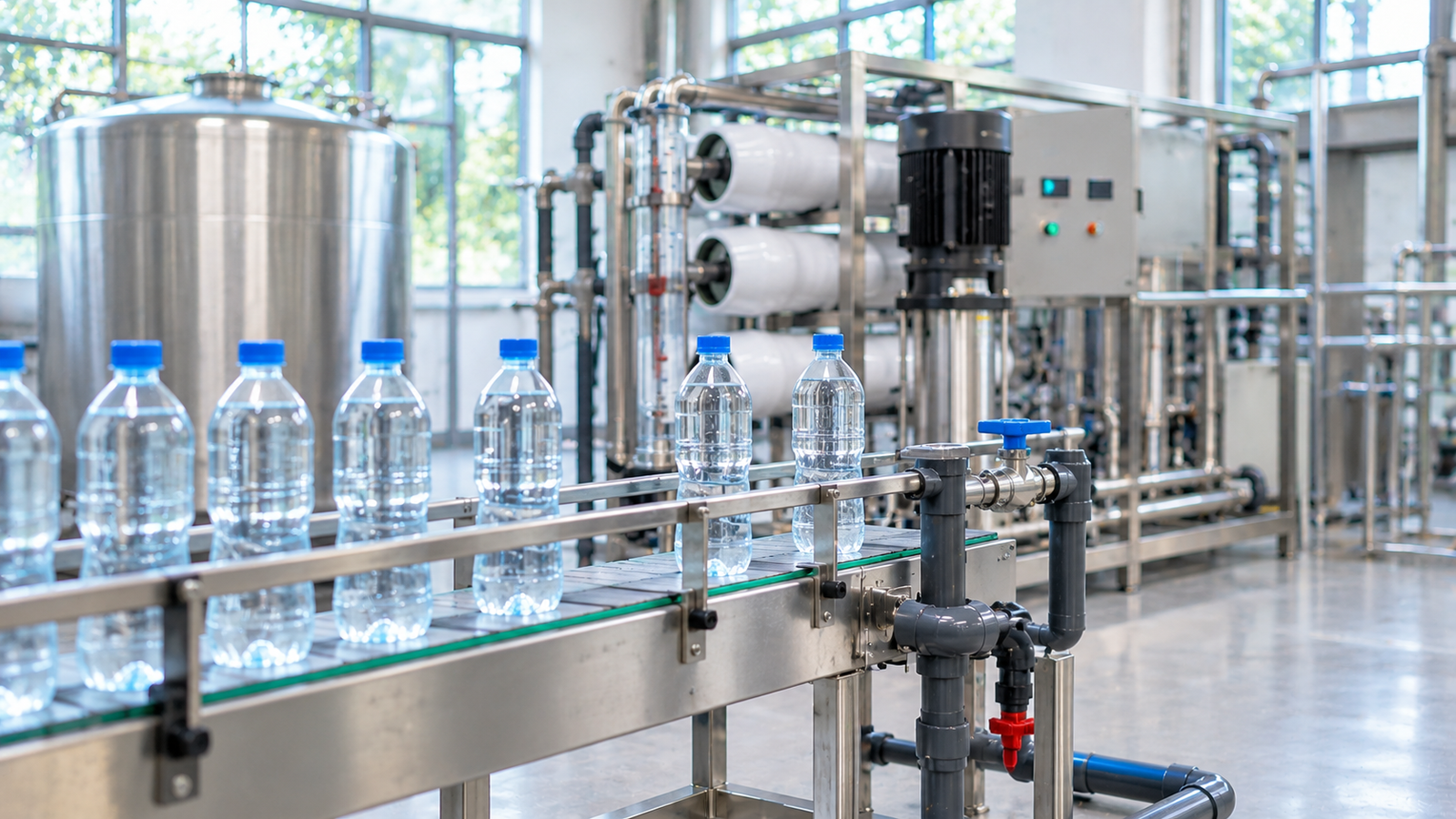
A commercial reverse osmosis system is more than an RO membrane and a high-pressure pump. It is a combination of treatment, control and water-handling components designed to produce water of a specified quality.
Depending on the application, a complete system may include:
- Feed-water storage or pressure regulation.
- Pretreatment to control suspended solids, chlorine, hardness, iron or other relevant contaminants.
- Cartridge filtration and the RO membrane unit.
- Instrumentation for pressure, flow and conductivity.
- Post-treatment, such as disinfection or remineralization, when required.
- Hygienic treated-water storage and distribution pumps.
Not every application needs every component. The appropriate configuration follows the water analysis and the required use of the treated water.
Start With Daily Water Demand, Not Machine Capacity
Suppose a small business needs 6000 liters of treated water each day.
If the RO system can operate for eight productive hours per day, the basic calculation is:
6000 L/day ÷ 8 hours/day = 750 L/hour
This is the minimum average production rate in an ideal calculation, before allowance for downtime, performance variation or changing demand.
A nominal 750 L/hour requirement does not automatically mean buying a 750 L/hour machine. Commercial RO systems are often offered in standard capacities, and the rated production may vary with feed-water temperature, salinity and membrane condition.
A nominal 1000 L/hour system could provide additional capacity in this example, provided that its actual output is verified for the operating conditions. It would theoretically produce 6000 liters in six hours at its full rated output.
Why Operating Hours Matter
Two businesses may use the same daily amount of water but require different RO capacities because their available operating hours are different.
| Daily Demand | Productive Hours | Minimum Average Output |
|---|---|---|
| 6000 L | 6 hours | 1000 L/hour |
| 6000 L | 8 hours | 750 L/hour |
| 6000 L | 10 hours | 600 L/hour |
| 6000 L | 12 hours | 500 L/hour |
The table shows basic arithmetic demand. It does not account for maintenance, cleaning, available storage, membrane performance or other design margins.
The practical question is not only how many liters your business consumes, but how consistently the system can produce that water during a normal working day.
Example: Planning 6000 Liters of RO Water per Day
Estimated total treated-water consumption during a typical business day.
Available productive operating time for the RO unit.
Minimum average output before design allowances.
Possible next step: Evaluate a nominal 1000 L/hour RO system against the feed-water conditions, required production schedule and storage needs. Confirm actual membrane output before final selection.
Illustrative sizing example. A final equipment specification requires feed-water analysis, membrane performance calculations and an operating plan.
RO Production Capacity Is Not the Same as Water Supply Capacity
This is one of the most important distinctions when planning an RO water system for a business.
The RO unit produces treated water at a particular rate. However, the equipment or people using that water may require a much higher flow for short periods.
For example, a hotel may consume relatively little water overnight but experience high demand in the morning. A filling operation may need treated water faster than the RO unit produces it while the filling machine is running.
In these situations, treated-water storage can separate the production schedule from the consumption schedule.
How Much Treated-Water Storage Do You Need?
Storage should be based on the difference between water production and consumption over time, not simply a fixed percentage of the RO system capacity.
Consider an illustrative facility consuming 2000 liters over one hour. If the RO system produces 1000 L/hour during that same period, the treated-water tank must supply the remaining 1000 liters.
Example peak-hour balance
Consumption: 2000 L/hour
RO production: 1000 L/hour
Required contribution from storage: 1000 liters
This calculation assumes that the RO unit is running at its intended output throughout the period. Actual tank sizing must also consider usable volume, minimum operating level, starting water level, downtime, replenishment time and an appropriate reserve.
For drinking-water applications, storage tanks and distribution systems must also be designed for hygienic operation. A large tank is not automatically beneficial if it creates unnecessary water residence time or contamination risk.
How Much Feed Water Does the RO System Need?
An RO system produces both treated water and concentrate. This means the feed-water flow must be greater than the permeate flow.
The basic relationship is:
Feed Flow = Permeate Flow ÷ Recovery Rate
For a system producing 1000 L/hour at an assumed 60% system recovery:
| Water Stream | Calculated Flow |
|---|---|
| Feed Water | 1667 L/hour |
| Treated Water | 1000 L/hour |
| Concentrate | 667 L/hour |
Therefore, the source-water supply must be capable of delivering approximately 1667 L/hour under these assumed conditions, not just 1000 L/hour.
The recovery rate is a design result, not a universal specification. It depends on membrane arrangement, dissolved salts, scaling risk, temperature and other operating constraints.
Why Source Water Still Determines the System Design
Even when daily demand and storage requirements are known, the RO equipment cannot be finalized without understanding the feed water.
Municipal water, groundwater and brackish water can require different pretreatment, membrane selection and operating pressure.
Important parameters include TDS, conductivity, hardness, iron, manganese, pH, turbidity and relevant scaling constituents. Additional tests may be necessary depending on the source and application.
For example, a groundwater source with significant hardness or iron may require additional pretreatment before the RO membranes. A higher-salinity source may require different pressure capability and recovery control.
Where the treated water is intended for drinking, the design must also address microbiological safety, post-treatment, storage and applicable local drinking-water standards.
Further reading: What Water Test Do I Need Before Buying an RO System?
What Size RO Water System Is Suitable for a Small Business?
Small commercial RO systems are available in different capacities. The suitable size depends on the application, productive operating hours and expected future demand.
| Nominal RO Output | Output in 8 Hours | Possible Applications |
|---|---|---|
| 250 L/hour | 2000 L | Small drinking-water points and limited daily demand |
| 500 L/hour | 4000 L | Small shops and limited commercial production |
| 1000 L/hour | 8000 L | Water businesses, workshops and small facilities |
| 2000 L/hour | 16000 L | Higher-demand businesses and production sites |
| 3000–5000 L/hour | 24000–40000 L | Growing commercial operations and multi-use facilities |
These are illustrative outputs at continuous nominal capacity. Application examples are not guarantees of suitability, and actual production must be checked against site conditions.
Should You Choose a Larger System for Future Expansion?
Some additional capacity can be useful when demand is likely to grow. However, oversizing increases initial equipment cost and may create operating difficulties if the system frequently starts and stops or spends long periods idle.
Before selecting a larger RO unit, consider whether storage, adjusted operating hours or a modular expansion plan could meet future demand more efficiently.
The objective is to achieve an appropriate balance between initial investment, reliable water supply and operating flexibility.
What Should a Commercial RO System Quotation Include?
A useful quotation should make it possible to understand not only what equipment is supplied, but also the conditions under which the proposed system is expected to perform.
- Design basis: Feed-water analysis, required permeate quality and assumed temperature.
- Production rating: Expected permeate flow under the specified operating conditions.
- Process configuration: Pretreatment, RO membranes, pumps and relevant post-treatment.
- Water balance: Expected feed, permeate and concentrate flows.
- Site requirements: Electrical supply, incoming water pressure, installation space and drainage.
- Storage and delivery: Clear identification of which tanks and distribution components are included.
- Maintenance: Consumables, cleaning provisions, replacement parts and operating guidance.
- Verification: Factory testing scope and agreed acceptance conditions.
Plan the Water System Before Choosing the Machine
A commercial RO water system should deliver the required quantity of treated water at the time it is needed and to the quality demanded by the application.
That requires several decisions to work together: daily demand, operating hours, peak consumption, storage, feed-water supply, treatment configuration and site conditions.
Start with those requirements. Then compare equipment specifications on the same basis.
Find an RO System That Fits Your Business
AquaOxy supplies compact RO water treatment systems in the 250–5000 L/hour range for small commercial and industrial applications.
Tell us your water source, daily demand, available operating hours and intended application. If you have a water analysis report, include it so that the treatment configuration can be evaluated more accurately.
Discuss Your RO System RequirementsTechnical reference: DuPont Water Solutions — Reverse Osmosis Technology. Site-specific membrane performance and operating limits should be verified using the selected membrane manufacturer’s technical documentation.