
To choose a 1000 L/hour RO system for your business, confirm that it can deliver the required water quality and volume from your actual source water. Then check the site utilities, complete equipment scope, maintenance arrangements, and acceptance conditions.
The capacity label tells you the proposed hourly output. It does not tell you which water the system can treat, what the finished water will meet, or what else you need before starting production.
1. Confirm That 1000 L/Hour Fits Your Production Schedule
Start with the total treated-water requirement per day, including water used outside the final product. Divide that volume by the reliable productive hours available.
For example, a business requiring 5,000 liters per day would need five productive hours if the system maintains 1000 L/hour. If cleaning and other activities use additional treated water, include those volumes separately.
A five-hour operating window would leave no allowance for interruptions in that example. Check startup, flushing, maintenance, raw-water availability, and power reliability before deciding the capacity is sufficient.
Also identify concentrated withdrawals. A filling machine or mixer may draw water faster than the RO production rate. Storage and a suitable delivery pump can support short peaks, provided the system can replenish storage between withdrawals.
2. Ask for Output and Water Quality Under the Same Conditions
Request a performance statement covering both product flow and product-water quality. These should refer to the same feedwater analysis, temperature, operating pressure, and recovery.
A proposal is incomplete if it promises 1000 L/hour under one set of conditions and a low product conductivity under another without explaining the difference.
Provide the intended use as well as the water report. Drinking-water production, food processing, and industrial equipment can require different finished-water specifications. Agree which parameters matter and where they will be checked.
If your source has seasonal changes, provide the known range. Ask whether the proposed system has been checked across that range rather than only at one convenient design point.
If testing has not been arranged, start with the water analysis needed before RO selection.
3. Review the Treatment Design Before Comparing Brands
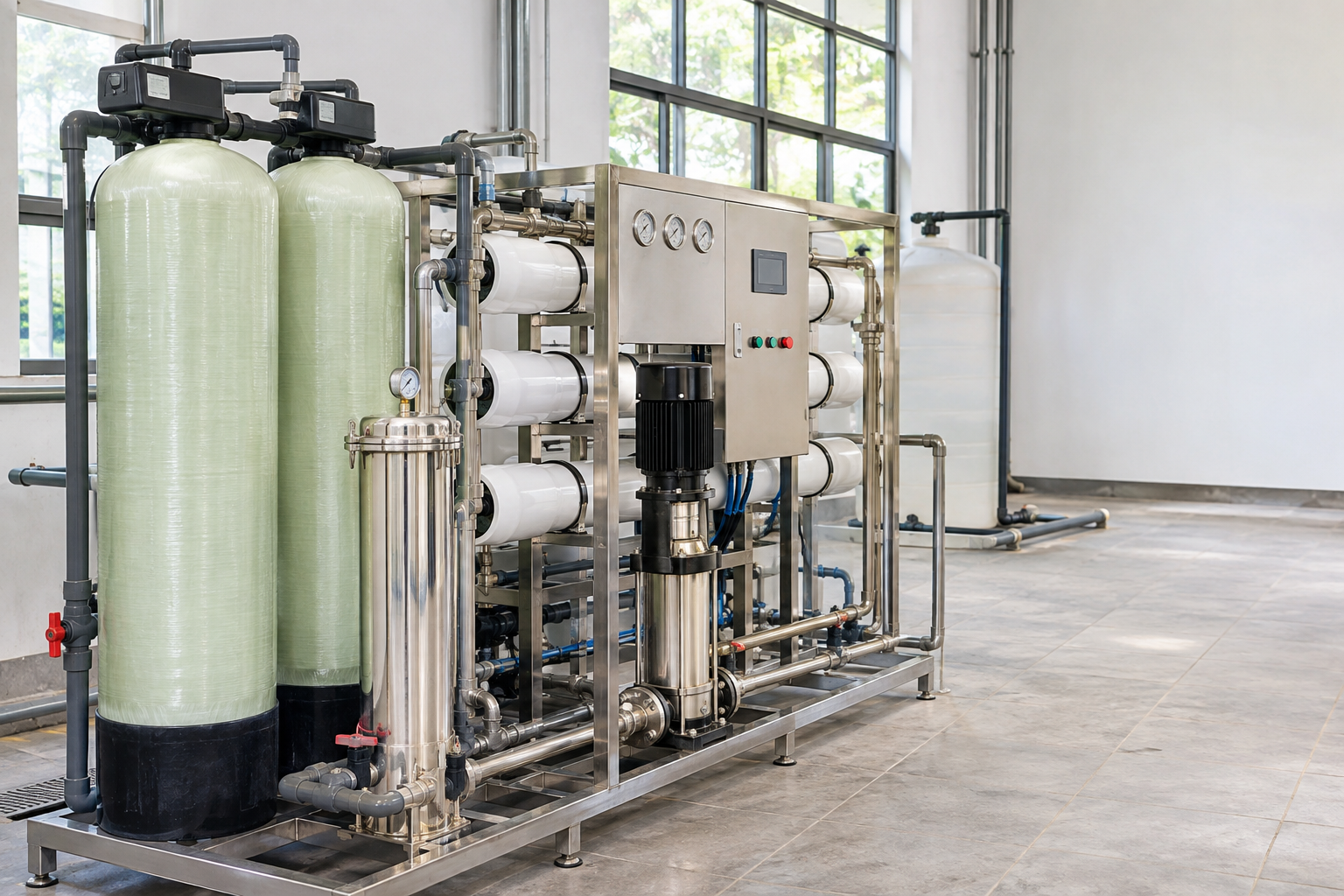
Ask the supplier to explain why each treatment stage is included. Pretreatment should address the actual feedwater conditions and protect the selected membranes.
For borehole water, that may involve particle removal, iron and manganese treatment, or scale control. For chlorinated water, suitable dechlorination may be needed before chlorine-sensitive membranes. The required arrangement cannot be determined by vessel count alone.
Pump and membrane brands are useful identification details, but the full models and their proposed operating conditions matter more than a brand name by itself. Ask for the membrane quantity and arrangement, pump duty, and design basis supporting the proposal.
Where internal recycling is used, distinguish circulating flow from incoming raw water and final concentrate discharge. Request a water balance that shows what your site must supply and discharge.
4. Check Utilities and Installation Space
Confirm the actual voltage, phase, and frequency at the installation point. “We have 220V” is not a complete electrical specification, and different systems with the same capacity may have different requirements.
Provide information about outages, generator use, and known voltage problems. Ask what electrical protection and restart arrangements are included, and what must be provided locally.
Check the incoming water flow and pressure, tank arrangements, and drainage. Confirm space for servicing as well as the equipment footprint, including cartridge replacement and membrane removal.
Photographs and a room layout help identify problems before shipment. Doorways, access routes, and the location of utility connections can affect installation even when the machine fits inside the room.
5. Make the Supply Scope Explicit
A commercial RO unit is not necessarily a complete water production installation. Ask for a written list of included equipment, optional items, and work assigned to your local team.
Clarify responsibility for:
- Raw-water and treated-water tanks.
- Transfer pumps and downstream delivery equipment.
- Any required final treatment or disinfection.
- Connecting pipework, cables, valves, and drainage.
- Commissioning, operator training, and initial consumables.
Confirm how membrane cleaning will be performed. Cleaning connections, a separate cleaning unit, and a complete cleaning service are different provisions.
Request a parts list with enough detail to order replacements later. Consumable availability and delivery time can affect the business long after the initial purchase.
6. Agree on Testing Before You Place the Order
Ask what will be tested before shipment and what will be verified after installation. Record the test conditions, measurements, acceptance criteria, and documents to be supplied.
A useful factory test record identifies the equipment and records relevant feedwater conditions, product flow, product quality, pressures, and operating settings. Controls and protective functions should also be checked against the agreed scope.
If factory test water differs from your source water, the result demonstrates performance under the recorded factory conditions. Agree how the design prediction and on-site verification will address your actual water.
For drinking-water applications, site storage, distribution, and filling equipment also need appropriate commissioning and verification. A factory test of the RO unit cannot establish the condition of equipment installed later.
Before ordering, resolve three questions: Is the promised performance tied to your water and required use? Is every essential supply item or site task assigned? Will the agreed tests provide evidence that you received the specified system?
Contact AquaOxy with your water analysis, intended use, daily demand, operating hours, and site electrical details. We can discuss a suitable 1000 L/hour RO configuration and clarify the proposed performance and supply scope.