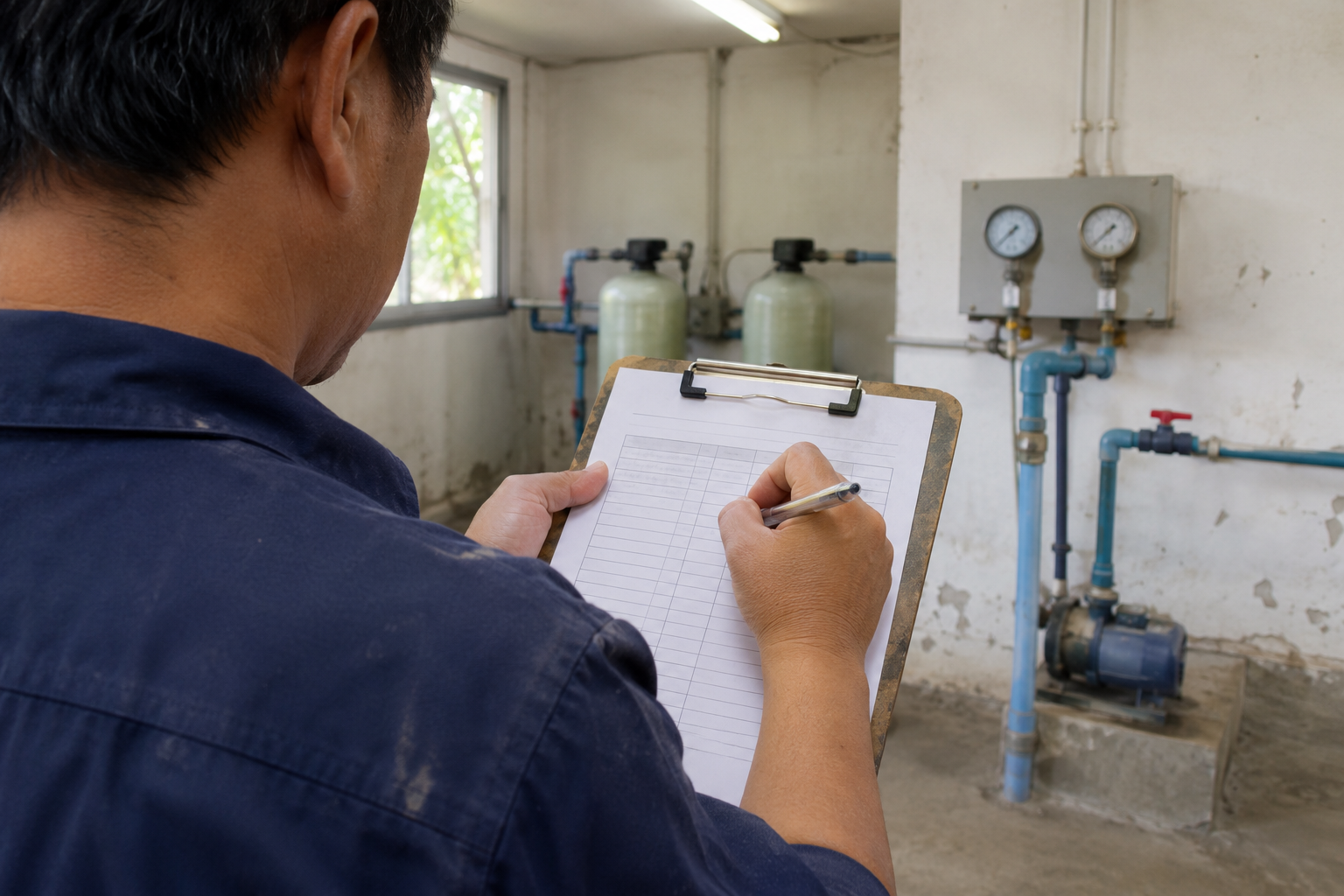

Hardness, iron and manganese can affect borehole RO systems in different ways. Hardness contributes to scaling risk, while iron and manganese can form deposits that foul treatment equipment. Their concentrations and behaviour help determine what pretreatment is needed before the RO membranes.
A water softener, an iron-removal filter, and an RO system perform different jobs. Selecting the right combination requires a water analysis and a clear operating plan, rather than adding the same equipment to every borehole installation.
This guide focuses on practical selection questions for small commercial RO systems from 250 to 5,000 L/hour.
1. Why Should Hardness, Iron and Manganese Be Checked Separately?
Water hardness mainly comes from dissolved calcium and magnesium. Water reports commonly express total hardness in mg/L as calcium carbonate, written as CaCO3.
Iron and manganese are separate constituents. A hardness result does not tell you their concentrations, and a TDS reading does not identify any of these parameters individually.
Visible scale, reddish staining, or dark deposits can provide clues, but appearance alone cannot establish the cause or concentration. Deposits may also involve corrosion products or other substances.
Ask the laboratory and equipment supplier which measurements are needed for your source. Include the sampling location and explain whether the water has already passed through a tank or treatment stage.
2. How Does Hardness Affect an RO System?
During RO operation, many dissolved salts become more concentrated in the reject stream. Some salts can precipitate when their solubility limits are exceeded, creating scale on membrane surfaces.
Hardness is part of that assessment, but it is not the only factor. The full water chemistry, pH, temperature, and proposed recovery influence scaling risk.
A hardness number alone is therefore insufficient to prescribe a universal recovery rate or chemical dose.
Depending on the design assessment, scale control may involve:
- Ion-exchange softening.
- An appropriately selected antiscalant and dosing arrangement.
- Adjustment of the proposed recovery.
- Other measures justified by the water chemistry.
Ask the supplier to explain the selected approach and its operating requirements. Antiscalant dosing and softening are not automatically interchangeable solutions.
3. Why Can Iron and Manganese Cause Problems Even When Water Looks Clear?
Some groundwater contains dissolved iron or manganese without obvious suspended particles. Exposure to air or oxidising chemicals can change their form and produce deposits.
This means the water entering an open tank may behave differently from water sampled directly at the borehole. The complete feed arrangement matters.
Iron and manganese deposits can foul RO membranes. Iron-bearing particles can also create problems for downstream softening resin.
Tell the supplier whether water is aerated, chlorinated, stored in an open or closed tank, or mixed with another source. Ask whether total and dissolved measurements are needed to understand the treatment challenge.
A cartridge filter can capture suitable particles, but it does not by itself establish effective removal of dissolved iron or manganese.
4. Can One Softener or Filter Handle Everything?
Do not assume that a standard softener is a complete solution for hardness, iron, and manganese together.
Some ion-exchange products can treat particular forms of iron under specified conditions. Their suitability depends on the resin, water chemistry, contaminant loading, and regeneration procedure.
A conventional softener should not be assigned this duty without confirmation from the designer and resin supplier.
Likewise, a tank described simply as an “iron-removal filter” needs more detail. Ask for the media specification, required feed conditions, service flow, backwash requirements, and any regeneration procedure.
Iron removal and manganese removal may require different operating conditions. Confirm that the proposed stage is designed for both when both are present.
If several treatment stages are proposed, ask the supplier to explain their sequence and how each stage protects or supports the next.
5. What Operating Requirements Should You Confirm?
Pretreatment must suit the site’s water supply, drainage, available consumables, and operator capability.
Before purchasing, confirm:
- The flow needed during normal service and filter backwashing.
- Required inlet pressure and available pump capacity.
- Backwash or regeneration frequency and how it is determined.
- Salt or chemical requirements, where applicable.
- Expected discharge volume and local disposal arrangements.
- Whether RO production must stop during these operations.
- How outlet hardness, iron, and manganese will be checked.
Do not size the raw water pump only against RO treated water output. The supplier should check both normal feed demand and pretreatment backwash demand.
Automation can manage valve sequences, but operators still need to replenish consumables, inspect equipment, and verify treatment performance.
6. How Do You Know Whether Pretreatment Is Working?
Agree on sampling points and acceptance limits for each relevant stage before commissioning.
A practical monitoring plan should identify:
- Which parameters to measure before and after treatment.
- Which tests the operator can perform and which require a laboratory.
- How often to test, including checks after regeneration or maintenance.
- What results require investigation or stopping the RO system.
- Who will review abnormal results and recommend corrective action.
Do not rely on treated water TDS alone to verify every pretreatment stage. Use hardness testing to check softening and appropriate iron and manganese tests to assess their removal.
Keep these results alongside operating records. A change in cartridge appearance or replacement frequency is useful information, but it does not replace testing.
7. What Should You Ask Before Ordering a Borehole RO System?
Send a recent water report, describe the route from the borehole to the equipment, and state your required treated water quality and daily quantity.
Ask the supplier to identify missing information rather than filling gaps with unverified assumptions.
Use three questions to review the proposal:
- Which measured water characteristics justify each pretreatment stage?
- Can our site support its backwashing, regeneration, consumables, and drainage?
- How will we verify treatment performance before water reaches the RO membranes?
If you are arranging an analysis, read What Water Test Do I Need Before Buying an RO System?
AquaOxy helps small businesses select RO systems from 250 to 5,000 L/hour based on source water, intended use, and operating conditions.
Contact AquaOxy with your borehole water report, daily water requirement, and details of any existing tanks or treatment equipment. We can review the information needed to discuss a suitable pretreatment and RO configuration.