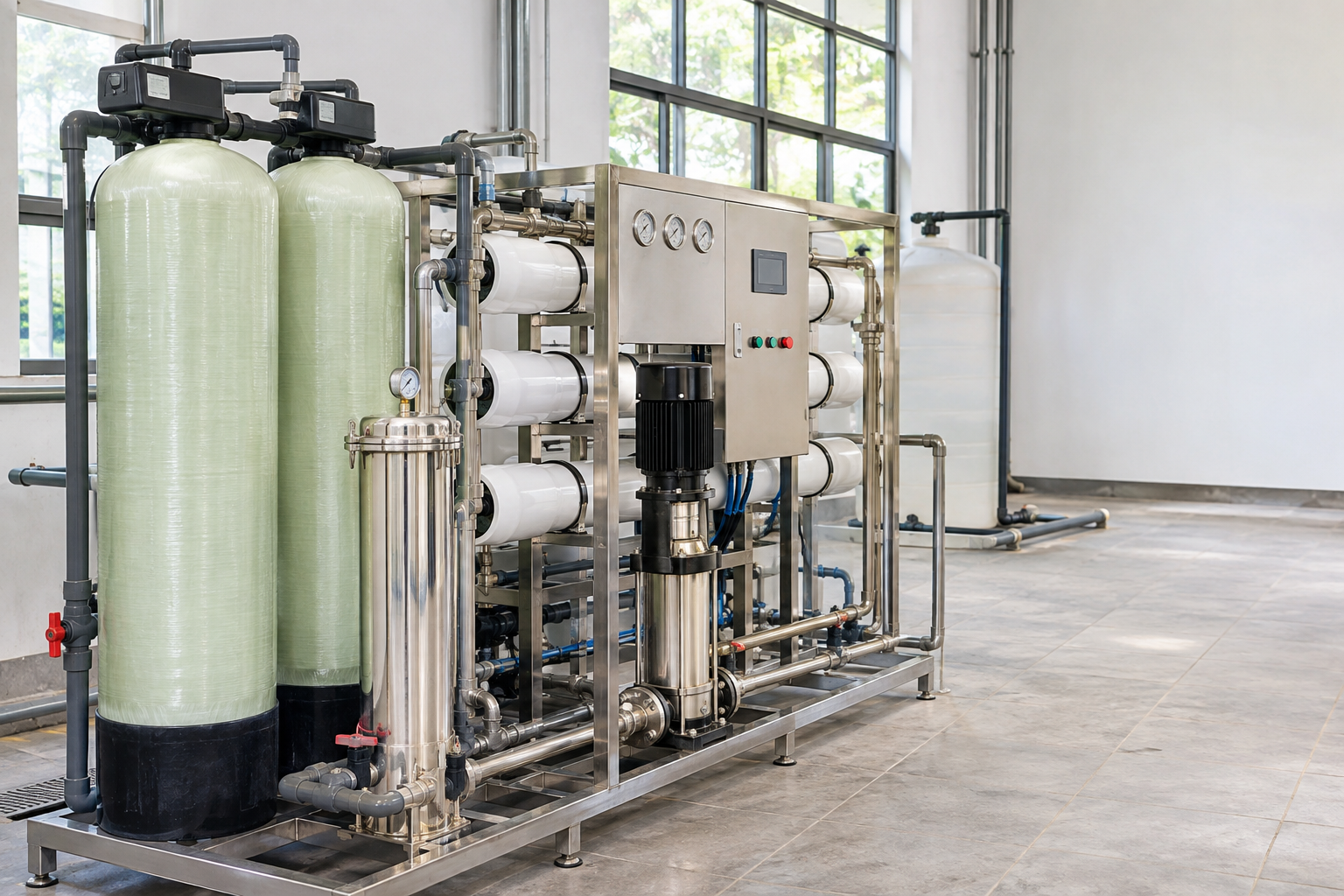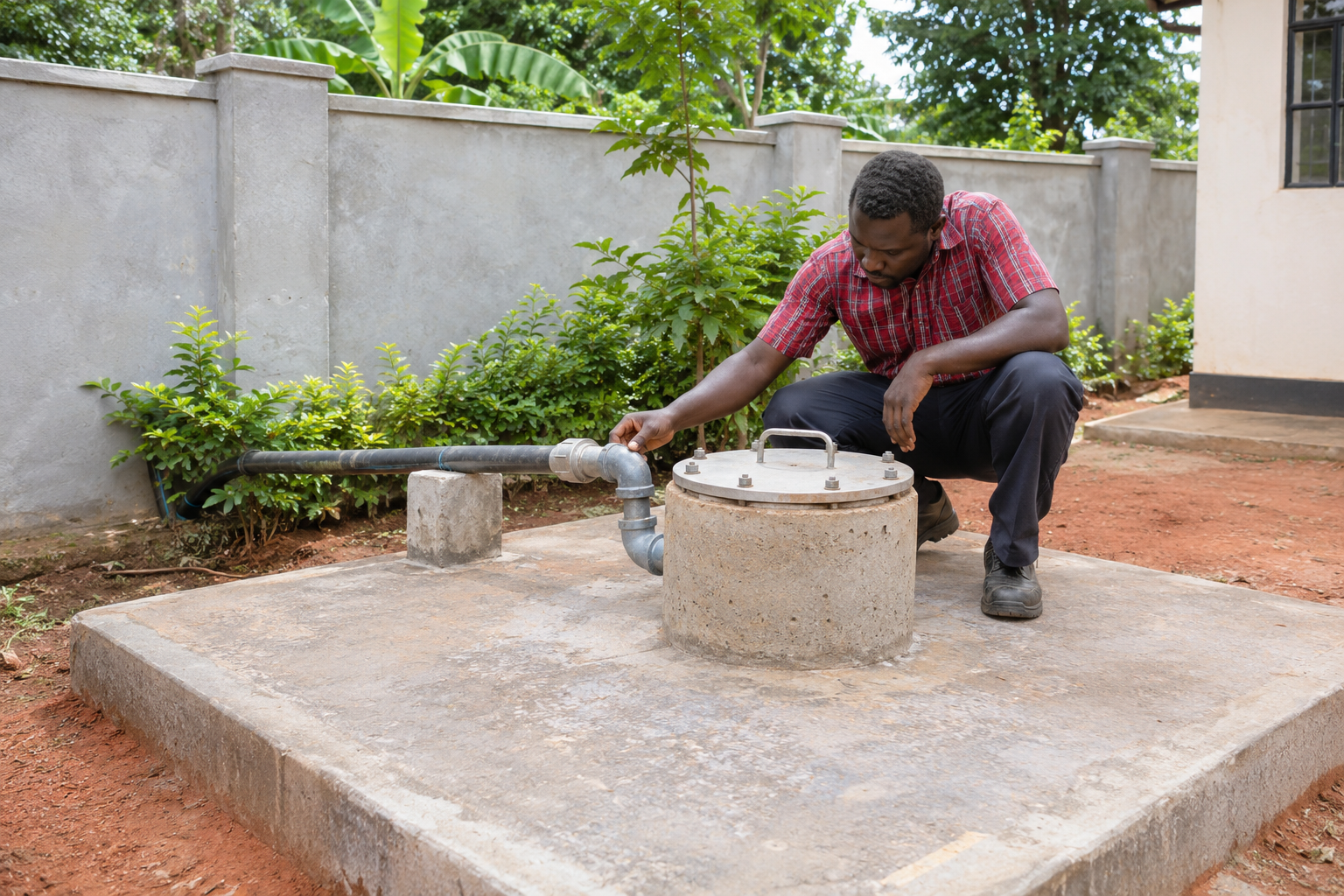
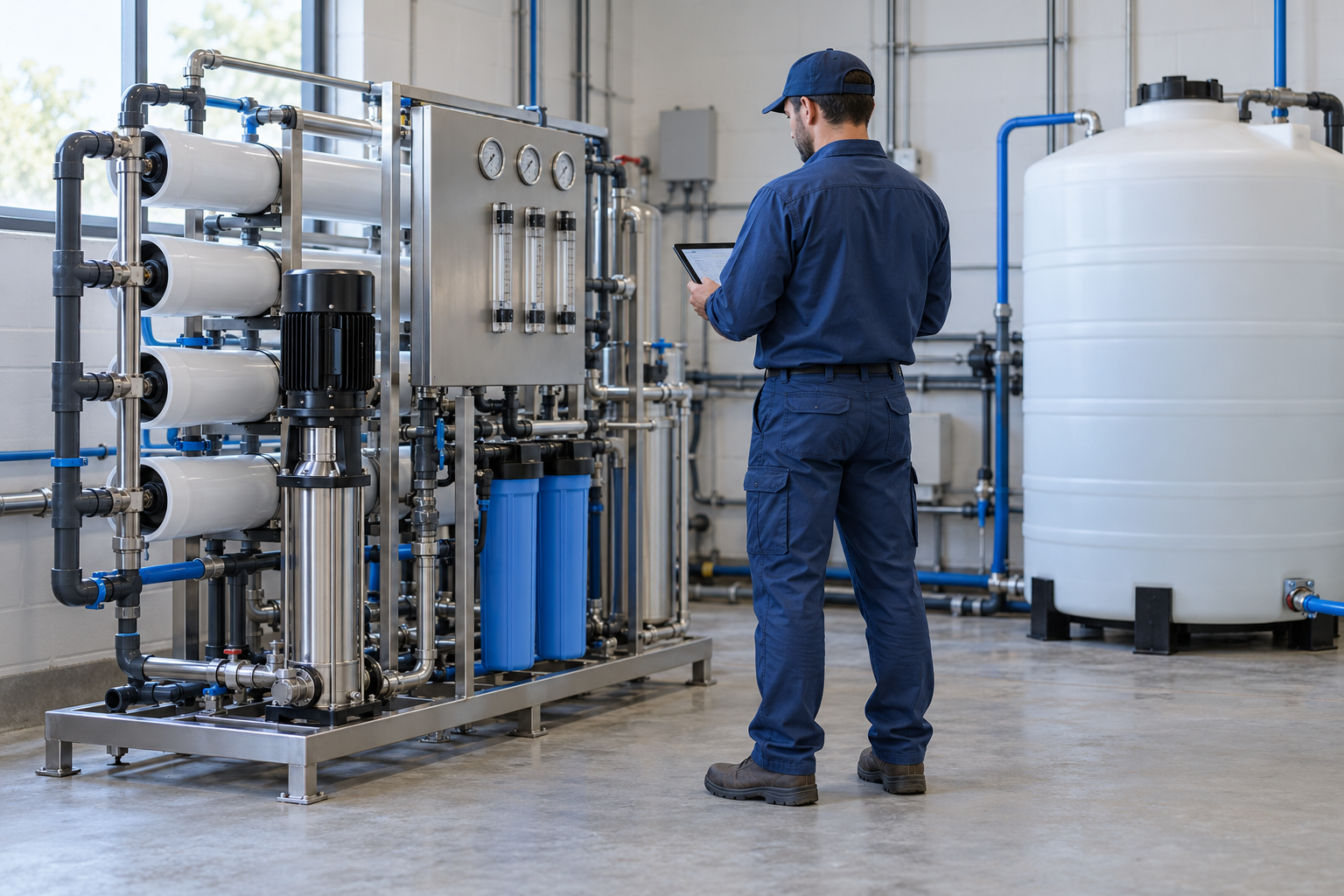
Higher RO recovery is beneficial when the system can maintain the required output and water quality within its approved operating limits. It can reduce feed water demand and concentrate discharge for the same permeate output, but it also changes conditions inside the membrane system.
A suitable recovery target depends on water chemistry, pretreatment, membrane arrangement, flow limits, and operating conditions. The highest percentage in a quotation is not automatically the best choice.
For small businesses buying RO systems from 250 to 5,000 L/hour, recovery should be evaluated alongside reliable production, maintenance requirements, and the cost of usable treated water.
1. What Does RO Recovery Actually Measure?
Recovery is the percentage of feed water that becomes permeate, also called product water.
Recovery (%) = Permeate flow ÷ Feed flow × 100.
For example, a simple system receiving 2,000 L/hour of feed and producing 1,000 L/hour of permeate operates at 50% recovery.
Recovery does not describe how much salt is removed. It also does not establish the hourly production capacity or confirm that the product water meets your application’s requirements.
When reviewing a quotation, ask which streams and process boundary are used to calculate the stated recovery, especially if the design includes recycle or multiple passes.
2. How Much Water Can Higher Recovery Save?
At the same permeate output, higher recovery reduces the feed volume required by the RO process.
For a simple system producing 1,000 L/hour without external recycle:
- At 50% recovery: approximately 2,000 L/hour of feed and 1,000 L/hour of reject.
- At 60% recovery: approximately 1,667 L/hour of feed and 667 L/hour of reject.
Over five production hours, the difference is approximately 1,667 litres of RO feed water and the same reduction in reject discharge.
These are illustrative calculations, not recommended settings. They assume both systems maintain the same product output throughout the period.
Actual site savings must also account for backwashing, regeneration, flushing, cleaning, and other water use.
3. Why Can Increasing Recovery Create Problems?
As more feed water becomes permeate, retained dissolved substances become more concentrated in the remaining water.
This can increase scaling risk and osmotic pressure. The consequences depend on the water composition and operating conditions.
The membrane arrangement must also maintain appropriate flows. Manufacturer design guidance includes limits such as maximum element recovery, maximum feed flow, and minimum concentrate flow.
This is why an approved recovery target requires more than a TDS reading or an adjustment to the reject valve.
A higher recovery design can be appropriate when these conditions are addressed. A lower recovery design can also be appropriate when it better matches the source water and operational constraints.
4. How Should You Compare Recovery Claims?
Ask suppliers to evaluate the same water analysis, required product quality, output, and temperature range.
For each proposed recovery, request:
- Expected permeate output and quality.
- Feed and final concentrate flows.
- Operating pressure and estimated electrical consumption.
- Pretreatment and scale-control requirements.
- Confirmation that membrane operating guidelines are satisfied.
- The feed water range over which performance is expected.
A statement such as “up to 75% recovery” needs conditions. Ask whether that value applies to your water, your chosen capacity, and the actual equipment being offered.
Do not assume a laboratory demonstration or another customer’s operating percentage transfers directly to your installation.
5. Does Higher Recovery Always Reduce Operating Cost?
No. Water savings are one part of the calculation. Compare the full operating estimate for the same quantity of usable product water.
Include:
- Raw water supply and reject disposal costs.
- Electricity consumption.
- Salt, chemicals, and replacement consumables.
- Routine maintenance and cleaning.
- Operator time and production interruptions.
- Any additional equipment required by the design.
Ask suppliers to state their assumptions. Cleaning frequency and membrane replacement costs should not be treated as guaranteed figures without a basis.
Higher recovery can be valuable where water availability or discharge is a constraint. Evaluate that benefit against the additional requirements, rather than judging the design by one percentage.
6. Can You Increase Recovery on an Existing RO System?
Possibly, but the proposed change needs review against the existing equipment and current water analysis.
Do not close the concentrate valve simply to reduce discharge. A changed valve position can affect several operating conditions, not just the volume sent to drain.
Send the supplier:
- Current feed analysis and temperature.
- Membrane models and arrangement.
- Feed, permeate, reject, and recycle readings where applicable.
- Operating pressures and product water quality.
- Pretreatment details and recent maintenance history.
Ask for an approved operating range and adjustment procedure. If a change is accepted, establish new baseline readings and monitoring requirements.
7. What Is the Right Recovery for Your Business?
The right target is a justified operating point for your water, equipment, required output, and maintenance capability. It is not a universal percentage for every municipal, borehole, or brackish water source.
Before accepting a proposal, ask three questions:
- What evidence shows this recovery is suitable for our water and membrane arrangement?
- What does it change in total water use, product quality, and operating cost?
- What checks and maintenance are needed to sustain it?
If your source water has not been analysed, start with What Water Test Do I Need Before Buying an RO System?
AquaOxy helps small businesses select RO systems from 250 to 5,000 L/hour based on source water, intended use, and operating conditions.
Contact AquaOxy with your water report, required output, operating hours, and any water supply or drainage constraints to discuss a suitable configuration and recovery target.